Fighting Fundamentalist

Sunday, September 16, 2007

Biblical Distinctives of Baptists:
A Layman's Perspective ©
Compiled by J. Wendell Cole

Getting Personal

Are you a Baptist by Conviction?

I am a Baptist! I am Baptist by Conviction! I am not ashamed to be a Baptist by conviction, and I hope you are not ashamed to be a Baptist either.

I have been a faithful member of Emmanuel Baptist Church in Toledo, Ohio and I, like you am still in the process of becoming the saint that Christ intends for me to become. “Why…” one may ask, “…is being a member of Emmanuel Baptist Church noteworthy?” The answer to that question puts this entire series into perspective, a layman's perspective.

Shortly after I was saved (late in 1983) I began to read and study, among a plethora of other things the “statement of faith” of many, many churches within my vicinity and a few out of my surrounding area. I wanted to obey God, to be baptized and become a member of a local body of believers with the same convictions of spirit and resolve of purpose. I didn’t know it at the time, but when I read the statement of faith of Emmanuel Baptist Church of Toledo, Ohio.... I did not have to look any further. I truly am a Baptist by conviction not by the convenience of birth or because it was the way I was raised (I think it would have been great to be raised in a Baptist home).

I, like everyone who becomes a member of Emmanuel Baptist Church, went through the new members classes. The class I went through was conducted by the pastor, the late Dr. Earnest Pickering. I began to rapidly build my personal library based on the “recommended books” from that class. I discovered that I was a reader; I read every single article of the General Association of Regular Baptist Churches and studied them out as well, asking, “What does the Bible say?” Yes, I have read every single one of them! I have read and reread “Portrait of Obedience” and “Biblical Separation”. If you have not read these books shame on you. ;-) The good news is, there is still hope for you to become a person of substance… you can go get them (at the churches library, the Christian book store, or from Regular Baptist Press) and read them, you will be glad you did. I am confident that you will gain a greater appreciation for the Baptist heritage, the General Association of Regular Baptist Churches, and learn more about true Fundamentalism.

I was born in 1960. I was born again December 15, 1983. I was raised in and therefore, formerly a member of a liberal Presbyterian Church (USA), and served on the education committee until I was convicted in my spirit that staying in that church was disingenuous on my part. I began a search for a church that still believed that the Bible was God's Word and followed Scripture faithfully. While I was in pursuit of a Bible believing church I maintained my membership at the liberal Presbyterian Church (USA) fulfilling my obligations of teaching the youth group (7-9 grades). I was also a consistent evening visitor at a charismatic Church of God. Furthermore, I was also a consistent Wednesday evening Bible study participant at a vibrant conservative Church of Christ (Disciples of Christ). I became a member of Emmanuel Baptist Church on March 3, 1985 and that with a whole hearted attitude about the fellowship there.

___________________________________

What about you my friend are you searching for a good church? That’s good; you should know I recommend Bible believing Baptist Churches. If possible try to find a GARBC church. If you live in the greater Toledo, Ohio area I highly recommend Emmanuel Baptist Church.

Having said all this, you need to know that no church can save you, not even a good church. Emmanuel Baptist Church in Toledo, Ohio can not save anyone, as good as it is. The only hope is Jesus Christ. Not a church, but a Person, a divine Person; the Lord Jesus Christ who died for our sins and rose again.

Jesus alone can and will save you if you will believe in Him to do so, and He will give you eternal life.

Perhaps you are saved, you know heaven will one day be your home because of the grace of God, but you have not been scripturally baptized in obedience to your Lord. You need to make arrangements to have that done.

It is conceivable that the Lord is calling you right now to serve Him as a teacher, a pastor, a teen leader, a nursery school worker, or one of the other various positions in your church that is lacking. This is a call to prepare as well. God uses those who are well trained and thoroughly equipped.
___________________________________

He came unto his own, and his own received him not. But as many as received him, to them gave he power to become the sons of God, even to them that believe on his name: Which were born, not of blood, nor of the will of the flesh, nor of the will of man, but of God. (John 1:11-13)

For God so loved the world, that he gave his only begotten Son, that whosoever believeth in him should not perish, but have everlasting life. For God sent not his Son into the world to condemn the world; but that the world through him might be saved. He that believeth on him is not condemned: but he that believeth not is condemned already, because he hath not believed in the name of the only begotten Son of God. (John 3:16-18)

For I delivered unto you first of all that which I also received, how that Christ died for our sins according to the scriptures; And that he was buried, and that he rose again the third day according to the scriptures… (1Corinthians 15:3-4)

The thief cometh not, but for to steal, and to kill, and to destroy: I am come that they might have life, and that they might have it more abundantly. (John 10:10)

Jesus said unto him, I am the way, the truth, and the life: no man cometh unto the Father, but by me. (John 14:6)

For by grace are ye saved through faith; and that not of yourselves: it is the gift of God: Not of works, lest any man should boast. (Ephesians 2:8-9)

Then they that gladly received his word were baptized: and the same day there were added unto them about three thousand souls. And they continued steadfastly in the apostles' doctrine and fellowship, and in breaking of bread, and in prayers. (Acts 2:41-42)

Not slothful in business; fervent in spirit; serving the Lord; Rejoicing in hope; patient in tribulation; continuing instant in prayer; Distributing to the necessity of saints; given to hospitality. (Romans 12:11-13)

All scripture is given by inspiration of God, and is profitable for doctrine, for reproof, for correction, for instruction in righteousness: That the man of God may be perfect, thoroughly furnished unto all good works. (2Timothy 3:16-17)

An email or comment is appreciated.

Your friend,
John

Friday, March 23, 2007

The Biblical Distictives of Baptists a Laymans Perspective

In the following pages you will find lessons I used for an Adult Bible Fellowship (i.e. an adult Sunday school class). The main curriculum I used was from Regular Baptist Press prepared by Donald K. Anderson and David M. Gower entitled The Biblical Distictives of Baptists (RBP 1992). This was my primary source and each family represented in our class recieved a student book by the same name. You may wish to consider these materials for your own church, or SS class thus I provided the links to them just point and click onto any highlighted word here (and any of my posts throughout this blog), if the pointer finger and underline appear just click. If you have trouble please let me know through email or in the comments links.

Throughout these posts I have tried to give my sources of information (often with a link), but I want to give place here to mention some of the best of the best sources that I used other than the Bible and the above mentioned curriculum. Some of these sources may be out of print and I am not taking time here to search them out or to link to them.

Baptists and the American Tradition by Robert C. Newman (RBP 1976)

Biblical Basis For Baptists by Duane Brown Ph. D. (RBP 1986)

God’s Blueprint for a Church by Kenneth Good (RBP 1974)

Principles and Practices For Baptist Churches byEdward T. Hiscox (Kregel Publications 1983)

The Doctrine and Administration of the Church by Paul R. Jackson (RBP 1986)

What Is a Baptist Association? By Jack Keep (RBP 1989)

A fine website packed with information is the General Association of Regular Baptist Churches, and for current articles I recomend checking out The Baptist Bulletin.

You may wish to use these posts for reference work. For example you may wonder "What do Baptists think about communion?" You may find out by clicking the "Archives" Jauary, February, or March, and scroll down till you see what you are looking for. Another way is to go to the top of the page, just above the banner to the left type in a key word or phrase and click to search blog. There you have it. May the reader enjoy and be encouraged with these posts and other sources herein.

Stay salty,
brother John

Saturday, March 17, 2007

The Biblical Distinctives of Baptists vs. The Fundamentals of the Faith

This blog is the overflow of an Adult Bible Fellowship (ABF) class that I had the priveledge in leading through “The Biblical Distinctives of Baptists”. I had preiviously posted these on The Earnest Contender Bolg. If you are not a Baptist you will, at least, be able to discover what Regular Baptists believe and why Baptists believe it. If you are a Baptist my aim for you is similar. I hope to provide you with greater clarification of the biblical distinctives of Baptists. This is a study of who we are, what we believe, why we believe it, and how to live as biblical Baptists. Please ask questions or make any remarks in the comments links below each post. This is a forum for you, and open for all.

Before we get into our study of biblical distinctives of Baptists it is important to understand that there are some doctrines that are prized higher to biblical Baptists than the Baptist distinctives. These prized doctrines have been referred to as “the fundamentals of the faith”. In my view, the fundamental truths that all true Christians must affirm and contend for are:

The Bible alone is the complete Word of God and His final authority to mankind, the source of true Christian unity.

The Creator is the Triune God, co-equal; Father, Son, and Holy Spirit.

Christ Jesus is God the Son, born of a virgin named Mary. He was fully God and fully man.

Jesus died on the cross, and shed His blood for the redemption of sinners. He was buried and rose from the dead and ascended into heaven physically.

Jesus Christ will return to this earth physically.
(there may be some wiggle room on this for certain a-millennial schemes, but this Baptist holds to pre-trib, futuristic pre-mill, dispensational position)

These fundamentals should trump any name or label. I have given further details on this topic at the following links. Fundamentals of the Faith Part 1, Part 2, Part 3, Part 4, Part 5, part 6, Part 7, Part 8, Part 9, Part 10, and Conclusion. This blog, however, is devoted to the study of, and understanding of The Biblical Distinctives of Baptists. My hope is that it will be helpful in bringing into focus each topic discussed.

In His fellowship,
brother John

What’s in a Name?

Labels Are Useful
Labels can be very useful. When shopping, one wouldn’t think about buying something that wasn’t clearly marked. In fact, most of us not only want to see the name of the product, but we also want to see the ingredients listed. Why would we want anything less when it comes to the most important matters of life? Before we go to a school of higher learning, we want to know about the school. Before we buy a car, we want to know what’s under the hood. Before we marry, we want to know what’s inside of that person who will become the most significant human being we will ever know. When choosing a place of worship and service to our Lord, shouldn’t we be at least as vigilant? In this post my aim is to list the ten ingredients, or distinctives, that make up a biblical Baptist Church. There may be some minor variations from one Baptist church to another, because there is no Baptist hierarchy to declare an official list, but nearly all will agree on these ten. Thus the label, or name “Baptist” will be more useful and important to the reader.

The Name Baptist Means Something
The name Baptist actually means something. It is a name that most will associate as a Bible believing, Christ honoring, Christian Church. The name “Baptist” is a meaningful descriptor of a doctrinal position, NOT a point of organizational pride. Baptists have a definite biblically distinctive doctrinal stance. Some churches that are not Baptist may hold to some of these positions. Then, there are some who call themselves “Baptist” who do not cleave to all of these biblical distinctives. There are yet other groups that do embrace all of these doctrines, but for one reason or another choose not to call themselves Baptist. I am a Baptist, and I am not ashamed to be called a Baptist. Baptists have a biblical foundation, a rich heritage, and a bright outlook on life. If you are a Baptist, I hope this post will encourage you to be a Baptist genuinely and not just by name. If you are not a Baptist you should be able to get the idea of what Baptists believe and why we believe it.

The Biblical Distinctives of Baptists
What are the biblical distinctives of Baptist? A useful tool to associate with this doctrinal body of thought is the acrostic, B A P T I S T. This acrostic will assist me by providing an outline for the future posts as well.

Biblical Authority
Autonomy of the Local Church
Priesthood of All Believers
Two Ordinances: Baptism and Communion
Individual Soul Liberty
Saved Church Membership
Two Offices: Pastor and Deacon
Separation of the Church and State

Will will be considering these distinctives throughout this blog. Let me know your thoughts about this acrostic, or any other related topic (agreements and disagreements) by using the comment prompt just below (that way we can engage in biblical discussion together). I welcome any questions you may have too. If there is any way I can be helpful to you, that's what it's all about.

Keep coming back!
Brother John

Biblical Authority

The Fundamental of Fundamentalism
Biblical authority is foundational to all the other doctrinal distinctives of biblical Baptists. This teaching is straight forward, and I think it is fairly safe to say, without controversy. The Bible alone is God’s completed Word of God and final authority for man. The Bible is God’s Word, not man’s word. The Bible makes certain and definite claims that do not appear in any other “holy book”.

The Bible Claims to be Eternal

It Stands Forever

The grass withereth, the flower fadeth: but the word of our God shall stand for ever. (Is. 40:8)

For all flesh is as grass, and all the glory of man as the flower of grass. The grass withereth, and the flower thereof falleth away: But the word of the Lord endureth for ever. And this is the word which by the gospel is preached unto you. (1Pet. 1:24-25).

The Bible Claims to be Without Error

It is Inerrant or Infallible (there are no mistakes in it)
As for God, his way is perfect; the word of the LORD is tried: he is a buckler to all them that trust in him. (2Sam. 22:31 and Ps. 18:30)

The law of the LORD is perfect, converting the soul: the testimony of the LORD is sure, making wise the simple. (Ps. 19:7)

The words of the LORD are pure words: as silver tried in a furnace of earth, purified seven times. (Ps.12:6)

Every word of God is pure: he is a shield unto them that put their trust in him. (Prov. 30:5).

The Bible Claims to be the Breath of God

It is plenary (i.e. all, or every portion of it) and verbally (i.e. the Holy Spirit lead in the choice of each word) inspired (i.e. lit. breathed out from God)
All scripture is given by inspiration of God, and is profitable for doctrine, for reproof, for correction, for instruction in righteousness: That the man of God may be perfect, thoroughly furnished unto all good works. (2Tim. 3:16-17).

This doctrine has been called “Sola Scriptura” which means that the Bible alone (and in its entirety) is the Word of God; this applies to all 66 of the canonical (recognized) Books from Genesis 1:1- Revelation 22:21.

There are many warnings in the Scriptures not to trifle with its sacred contents. Yet there are those who feel that parts of the Bible can “become” God’s Word as one reads them. The idea that there are select portions that are, and other portions that are not, God’s Word does not jell with what the Bible itself states in 2Tim. 3:16, “All scripture is given by inspiration of God…” The Bible not only contains God’s Word, it is God’s Word through and through.

The Bible is the supreme truth: over-ruling human reason, tradition, experience, and knowledge. All other writings and experiences should be evaluated as they line up with the Bible. No one has a special “inner light” or anything else that can replace, add to, or take away from, what is already revealed in the Bible. There is no authority given to any organization, clergy leader which goes beyond, above, or equal to the authority of the Bible. This includes extra books and writings, so-called visions, dreams, tongues, and feelings or thoughts which some groups call “direct revelation from God”. None of this is authoritative, the Bible alone is.

Check out my post on How God Communicates and please leave a comment or question here or there. All are welcome including those who are theological liberals, neo-orthodox, charismatic, and spiritualist. Perhaps you’re one who doesn’t like the idea that God reveals Himself through the Bible, or you have some other authority to govern your life. This is a good place for courteous dialogue. Q&A is always welcome.

All scripture is given by inspiration of God, and is profitable for doctrine, for reproof, for correction, for instruction in righteousness: That the man of God may be perfect, thoroughly furnished unto all good works. (2 Timothy 3:16-17)

In His fellowship,
Brother John

Friday, March 16, 2007

How to Approach the Scriptures (Part 1)

The Bible, God's Word
I hope that the reader has come to the conclusion that the Bible is the sole authority of faith and practice, for it is without error in every matter of which it speaks. The Bible is, after all, God’s Word. Here are some places where this is taught:

The Spirit of the LORD spake by me, and his word was in my tongue. (2Sam. 23:2)

Every word of God is pure: he is a shield unto them that put their trust in him.
Add thou not unto his words, lest he reprove thee, and thou be found a liar.
(Prov. 30:5-6)

For verily I say unto you, Till heaven and earth pass, one jot or one tittle shall in no wise pass from the law, till all be fulfilled. (Matt. 5:18)

Sanctify them through thy truth: thy word is truth. (John 17:17)

If he called them gods, unto whom the word of God came, and the scripture cannot be broken; (John 10:35)

Men and brethren, this scripture must needs have been fulfilled, which the Holy Ghost by the mouth of David spake before concerning Judas, which was guide to them that took Jesus. (Acts 1:16)

These were more noble than those in Thessalonica, in that they received the word with all readiness of mind, and searched the scriptures daily, whether those things were so. (Acts 17:11)

Which things also we speak, not in the words which man's wisdom teacheth, but which the Holy Ghost teacheth; comparing spiritual things with spiritual. But the natural man receiveth not the things of the Spirit of God: for they are foolishness unto him: neither can he know them, because they are spiritually discerned. (1Cor. 2:13-14)

Now all these things happened unto them for examples: and they are written for our admonition, upon whom the ends of the world are come. (1Cor. 10:11)

Now to Abraham and his seed were the promises made. He saith not, And to seeds, as of many; but as of one, And to thy seed, which is Christ. (Gal. 3:16)

And that from a child thou hast known the holy scriptures, which are able to make thee wise unto salvation through faith which is in Christ Jesus. All scripture is given by inspiration of God, and is profitable for doctrine, for reproof, for correction, for instruction in righteousness: That the man of God may be perfect, thoroughly furnished unto all good works. (2Tim.3:15-17)

God, who at sundry times and in divers manners spake in time past unto the fathers by the prophets,Hath in these last days spoken unto us by his Son, whom he hath appointed heir of all things, by whom also he made the worlds; (Heb. 1:1-2)

We have also a more sure word of prophecy; whereunto ye do well that ye take heed, as unto a light that shineth in a dark place, until the day dawn, and the day star arise in your hearts:this first, that no prophecy of the scripture is of any private interpretation. For the prophecy came not in old time by the will of man: but holy men of God spake as they were moved by the Holy Ghost. (2Pet. 1:19-21)

And account that the longsuffering of our Lord is salvation; even as our beloved brother Paul also according to the wisdom given unto him hath written unto you; As also in all his epistles, speaking in them of these things; in which are some things hard to be understood, which they that are unlearned and unstable wrest, as they do also the other scriptures, unto their own destruction. (2 Peter 3:15-16)

For I testify unto every man that heareth the words of the prophecy of this book, If any man shall add unto these things, God shall add unto him the plagues that are written in this book:if any man shall take away from the words of the book of this prophecy, God shall take away his part out of the book of life, and out of the holy city, and from the things which are written in this book. (Rev. 22:18-19)

This by no means is an exhaustive list, but it is comprehensive.

The Bible, God's Teachings
Having come to the conclusion in my own life, that the Bible is my sole authority of faith and practice it is now essential for me to yield to its teachings whether or not I can intellectually understand and/or immediately agree. More properly I should say that, “I need to submit to God’s teachings” for that is what the Bible is: God’s teachings. I am reminded of the event that took place and was recorded for us in Acts 8:27-35, where Phillip led a one-on-one Bible study of the book of Isaiah 53 with a man from Ethiopia. The Ethiopian wasn’t quite sure of whom the Prophet spoke. He had not, at this point, had a course on hermeneutics (interpretation). God took care of the first things first: Phillip began at the point where the Ethiopian was and presented the Gospel and the Ethiopian believed and was baptized (by imersion).

Some have used this as a proof text for their philosophy that every passage in the Bible points to Christ. This method of interpretation is called the Christological approach. Others, closely related to the first group, use this passage to enforce the idea that every verse in the Bible points toward salvation of man or has to do with some aspect of God's salvation program. This method of interpretation is the Soteriological approach. The esteemed C.H. Spurgeon said to his students, “Choose your text, then make a bee line for the cross!” Before I assert what in my view is the best approach to Scripture, I will offer these preliminary remarks. It should be clear that I have a warmth and brotherly affection for Christians who do not agree with me. We are brothers in Christ! Some choose to call themselves “reformed”, “covenantal”, “new covenantal” and “progressive dispensational”, "dispensational" and so on. In these systems of thought many are conservative and seek to follow the teachings of God. There are also a great number of theologians and preachers in these groups who have much to offer the church and the individual believer. I personally praise the Lord for their commitment to the Bible and God. I am also friends with many in these groups and I am confident that they would say the same of me.

Some may argue that language is a hindrance to God, but I humbly suggest it is NOT! God is perfectly capable to condescend to our human language which He invented, and this is also how He chooses to communicate to us. Let me quote Alice, when she was in Wonderland, “...say what you mean and mean what you say.” This is basically what the Ethiopian was saying to Phillip… and it turns out that this is exactly what God has done for us in His Word the Bible. It is a marvelous Book, a special Book, a divine Book, and yes, a spiritual Book, but the simple fact remains: it is a Book! We must read it, and read it properly if we are to know what God wants to reveal to us from it. The question is “How are we to read this Book?” We will try to answer this question in part two as we explore the proper approach the Scriptures. Our approach to Scripture is vitally important don’t you agree?

In His service,
Brother John

Sunday, March 11, 2007

How to Approach the Scriptures (Part 2)

I have spoken of the Soteriological and/or the Christological approach to the Scriptures in the last post; These two are certainly popular and increasing in Christendom they each in there own stride have some strengths. I personally uphold the Doxological approach. Why? I'm glad this question came to your mind, the Doxological approach seeks to understand how Scriptures relate to God’s glory, or putting it another way, it views God’s glory in every text. It is by far the best approach and I aim to defend it here and at every turn. This is not at all in rebellion to my heritage as a former Presbyterian; I do come from a long line going back to the Scottish Reformation, and I have respect for my Presbyterian and Refomed brothers and sisters. Yes we disagree from time to time. My approach is due to the conviction derived from the evidence of objective truth found in the Bible.

The Doxological approach is best because it is not limited to one specific “plan” or “program” or “purpose” and therefore is free to examine every portion of Scripture as it relates to the glory of God and that is the way I think it should be. Not only in areas of Soteriology and Christology but in the wider range of Bible doctrine. God does not have just one program (eg. the salvation of mankind). He is concerned with Israel and also the Gentiles; Salvation and His church; Government and human conduct, morally and relationally, the whole of His creation; visible and invisible. The doxological approach does not strain at a nat then attempt to swallow a camel. It follows a plain or normal hermeneutic (interpretation) consistantly. Let me explain, there are mainly two methods of hermeneutics, and here lies the greatest divide between biblical thinking Christians today. Both start with Sola Scriptura as a premise, but as we will see this is where the two schools of thought end in similarity.

The Allegorical Method
The allegorical method of interpretation produces covenant theology, and visa versa. Desiring to see Christ, or His plan of salvation for mankind, the allegorical interpreter must seek a deeper hidden meaning. I would love to go on a rabbit trail and discuss Origins trichotomy of man theory and how it affects this method, but I will refrain (perhaps another post or as questions and comments dictates) for now. The allegorical method can be found as early as 200 AD from Alexandrian school of thought.

The Plain or Normal (not necessarily literal) Method
The plain or normal (not necessarily literal) method of interpretation produces Dispensational Theology and not the other way around. Each text is unfolded consistently in its plain or normal rendering. Seeking nothing but God’s glory, it too can be found as early as 200 AD from the Antiochene school of thought. This is the Doxological approach!

The later is the best approach because it is Grammatical: considers all the parts of the grammar in each text treated. Historical: considers the historical background of each text treated. Theological: considers the teachings of God in each text treated.

There are four prerequisites for proper interpretation, first you must be saved, second you must depend on the Holy Spirit as your teacher, thirdly you must be teachable, and finally you must be willing to obey. These are prerequisites NOT guarantees. The correct interpretation depends on these requirements with out them… FORGET IT! Even with them it is still possible for one to make mistakes. That’s why we interpret grammatically, historically, and theologically; according to the immediate and wider contexts and in harmony with the whole Bible comparing Scripture with Scripture. There are some difficulties with this approach, but it is the most reliable way to get the best out of ones study in the most important Book, the Bible.

Stay Salty,
brother John

Friday, March 09, 2007

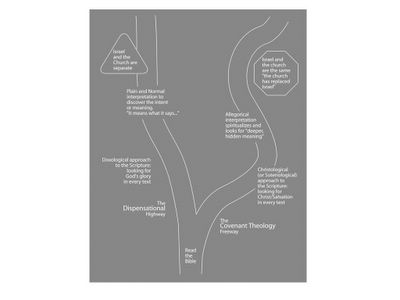
The Two Roads Graphic: Explained


TWO ROADS

The two roads graphic is a custom design that my wife created for me when I was teaching a course on Systematic Theology. It really looks good on an overhead. She is working on figuring out graphic/photo additions to blogs. In the mean time I will share with you what it is. It is a picture of a road that comes to a fork. The name of the road is Read the Bible then it branches off in two directions. The right side exit ramp is The Covenant Theology Freeway. The left side is the entrance ramp to The Dispensational Highway. That’s the road less traveled nowadays, but it is the way I choose or am predestined to go.

On the Covenant freeway there are some landmarks. The first landmark is the Christological or Soteriological approach to the Bible: looking for Christ or salvation in every text. The next landmark is Allegorical interpretation … which tends to spiritualize and look for “deeper hidden meaning”. Then we come to a stop sign because this approach will lead us to the false conclusion that Israel and church are the same, or as my covenant brothers say “the church has replaced Israel”.

On the Dispensational Highway there are also some landmarks. The first is the Doxological approach to Scripture: finding God’s glory in every text. The next landmark is the plain and normal interpretation to discover the intent or meaning, “It means what it says…” We then come to a yield sign that reads, “Israel and the church are separate”
I hope this explanation helps to clarify the poor display.

Autonomy of the Local Church

We have covered the "B" which stands for Biblical Authority (I discussed different ways that Baptists might approach the Bible, but we should all agree that it is our Authority.) Now we will move on to the "A".

Autonomy of the Local Church
The autonomy of the local church is one of the premiere distinctives of biblical Baptists. Denominational churches (even some Baptist groups) can't lay claim to this one. Most main line churches eschew it, yet it is what Baptists believe best represents the New Testament pattern for local churches. The words “autonomy”, “independent”, and “sovereignty”, all mean “self- rule” or “self- governing”. In other words, biblical Baptists have no outside ecclesiastic control. No hierarchy of any kind. No district superintendent. No Synods, General Assemblies, Bishops, Cardinals, or Popes. Biblical Baptists are distinctly autonomous in their government. However, even though biblical Baptists are autonomous they do follow an authority structure.

Who is NOT in Charge?

The Pastor/s?
The question is, “Who is not in charge then?” Bishop (overseer), pastor (shepherd), elder (presbyter), are three words that describe the pastor who is designated in Scriptures as an officer (1Tim. 3:1), but the pastor does not control a biblical Baptist church. So called elder rule is not the best model to follow.

The Deacon/s?
The deacon is a helper of the pastor and the servant of the church, and is also designated in Scriptures as an officer (1Tim. 3:10), but deacons are not in control of a biblical Baptist church.

The Church?
The Church (including the pastor/s, the deacons, and the congregation) has the final say in the official business of the church (as we will see). In fact biblical Baptists have both a Congregational and Presbyterian model of government, yet the church is not in control of a biblical Baptist church.

The church is autonomous in that:
The church disciplines its own members (Matthew 18:15-17).
The church appoints its own deacons (Acts 6:1-7).
The church sends out its own missionaries who are accountable to the church (Acts 13:1-3; 14:26-27).
The church judges and restores its own members (1Corinthians 5).
Yet each church is accountable to God (Revelation 2-3) this is a clue for the answer to our question.

Not the Pastor, Not the Deacons, Not the Church!

Who Then is in Charge?

The answer is found in the Bible. The Bible as we have established is the authority, no mater how we approach it, and we read in Ephesians 1:22-23 and Colossians 1:18 that Christ is the Head of the church. Godly pastors, deacons and church members directed by Jesus Christ Himself , the Head of the church, through the Person of the Holy Spirit working together in each member of the church. There are biblical guidelines to follow; God is not saying, “OK. You take over from here, best of luck to you.” Each church member must be tuned into God through His word and prayer. The authority resides in the total membership under the control of Christ. The natural consequence or privilege is that each member has greater responsibility for the conduct and direction of the church than members of other hierarchal groups. I will touch on these responsibilities in the priesthood of every believer. Does your local church follow this model or some other form? What duties do you have that contribute to your local fellowship?

“What a lovely and delightful relationship exists between pastor, deacons and people when all are subject to Christ the Head.” (Dr. Paul Jackson, National Representative of the GARBC from 1960-1969)

The best expression of Christian fellowship is within a Bible believing church!

Tuesday, March 06, 2007

The series we are currently working through here is called The Biblical Distinctives of Baptists.

My aim is to encourage a greater understanding of what the name Baptist means:

  • Baptist, not just in name, but by conviction of the biblical truths presented
  • Baptist, not just in conviction, but also by name
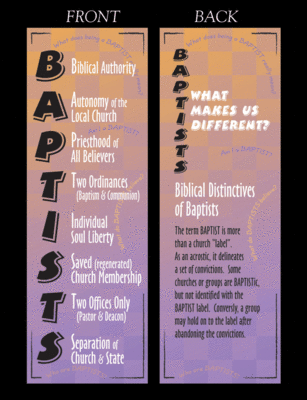
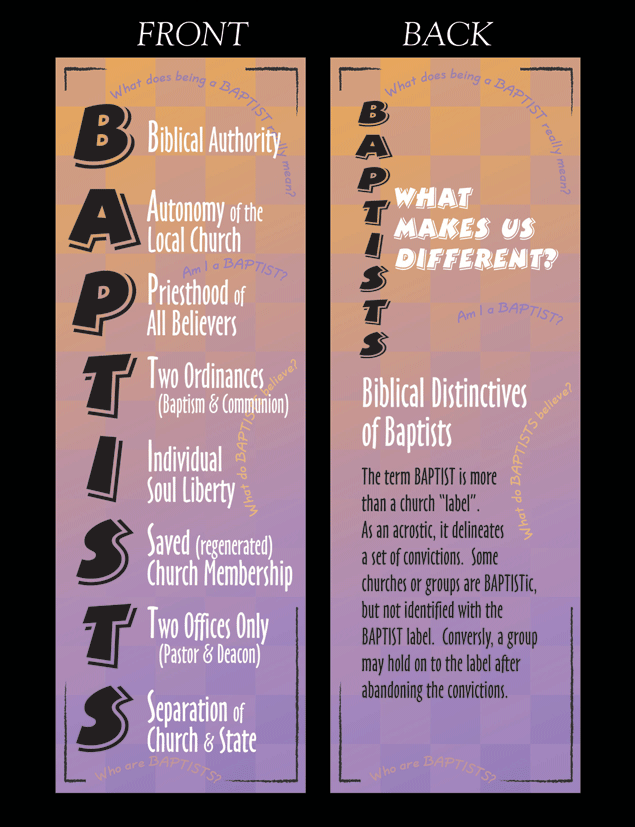
My wife, Rose, designed this bookmark for those in our Adult Bible Fellowship (ABF) class. If you click on it, you may see the details. I invite your comments ... especially regarding the statement on the back of the bookmark.

Just in case you can't read the graphic (let me know if you can or can't), these are the 8 points of the acrostic that we have been covering:

  • Biblical Authority
  • Autonomy of the Local Church
  • Priesthood of All Believers
  • Two Ordinances (Baptism & Communion)
  • Individual Soul LibertySaved (regenerated) Church Membership
  • Two Offices Only (Pastor & Deacon)
  • Separation of Church & State

And here's the paragraph of text from the back, that I was looking for feedback on:

The term BAPTIST is more than a church "label". As an acrostic, it delineates a set of convictions. Some churches or groups are BAPTISTic, but not identified with the BAPTIST label. Conversly, a group may hold on to the label after abandoning the convictions.

In His fellowship,

brother John

New Testament Authority and Our Baptist Distinctives

According to E. T. Hiscox, A Baptist historian from yesteryear,
“It is on all hands conceded, that from the days of the Apostles to the Reformation, there existed congregations and communities of Christians separate from the prevailing and dominant churches… these separate communities maintained their distinct existence, worshiped by themselves, and served God according to their understanding of the Scriptures and the dictates of their consciences.”

These kind of churches, that held to New Testament Authority, are most commonly called Baptists. Perhaps they were known by other names (Messalians, Euchites, Montanists, Novatians, Paulicians…etc.) and/or some peculiar doctrines, but we can see throughout history, since the time of Pentecost, there have been such churches.

We are studying the Biblical Distinctives of Baptists. These distinctives are presented in an acrostic
B-A-P-T-I-S-T

Modern day Baptists (not modernist) arrived at these distinctives through careful study of the Bible. That is why these teachings are more precisely called the Biblical Distinctives of Baptists and not Baptist distinctives. In other words, these teachings are common among Baptists because individual Baptist churches have consistently and independently discovered them in God's Word, the Bible and held to them, not because some group of Baptist leaders composed the list and then imposed the distinctives on local churches. (In fact, there is no ecclesiastical hierarchy in an autonomous group… and the “A” stands for Autonomy of the local church.)

Church groups other than Baptists have held some of these Biblical distinctives, and one may even find churches that hold all of the distinctives but do not call themselves Baptist. Such groups are "baptistic", but for some reason they choose not to be identified as Baptists. On the other hand, some churches naming themselves Baptist are not truly Baptist because they no longer hold the historic Baptist beliefs or even the fundamentals of the Christian faith.


Baptists are people of the Book!
Baptists are people of the Book above all else... and Baptists enjoy a priceless heritage of generations who have exalted God's Son, our Savior and have proclaimed God's inspired Word.

“The Baptist name is not a point of organizational pride but a meaningful descriptor of a doctrinal position.” -D. Anderson

The Priesthood of Every Believer

The series we are currently working through is called "The Biblical Distinctives of Baptists". There is an acrostic that we are following. You can see it above on the "bookmark". This post will cover the letter "P" in the word BAPTIST. The "P" stands for the Priesthood of every believer.
I’ll not soon forget, if ever, a message entitled “How I Became a Catholic Priest,” by the thunderous preacher, Dr. Earnest Pickering. He didn't mince words over what he called “priest-craft”. "It is used by many cults which esteem men to a place of such religious stratosphere it could make one’s ears pop and cause the nose to bleed." I agree with him, the importance placed on a “special class of men and/or women” is nonsense and is not supported by the New Testament! The word "Priest" is defined as "...one authorized to perform the sacred rites of a religion, especially as a mediatory agent between humans and God." (Websters)

The word “priest” appears in not less than 846 verses in the Bible (AV). It appears first in Genesis 14: 17-19; It seems that God had at least one priest before Aaron came along;

…the king of Sodom went out to meet him [Abram] after his return from the slaughter of Chedorlaomer, and of the kings that were with him, at the valley of Shaveh, which is the king's dale. And Melchizedek king of Salem brought forth bread and wine: and he was the priest of the most high God. And he blessed him, and said, Blessed be Abram of the most high God, possessor of heaven and earth…

Later God made this conditional promise to Israel:


Now therefore, if ye will obey my voice indeed, and keep my covenant, then ye shall be a peculiar treasure unto me above all people: for all the earth is mine: And ye shall be unto me a kingdom of priests, and an holy nation. These are the words which thou shalt speak unto the children of Israel. And Moses came and called for the elders of the people, and laid before their faces all these words which the LORD commanded him. (Ex. 19:5-7)
I am a Baptist priest! In fact every believer today is a priest of God, no matter what denomination or creed. But what is our basis for being priests? A better question would be, “Who is the basis for our priesthood?” It is none other than the great high priest, Jesus Christ Himself! When Jesus hung suspended between Heaven and earth on the cross, the curtain of the holy of holies was rent in two from top to bottom. He opened the access to God, and the Bible declares that all who trust in the finished work of Christ are priests. Priests may enter into God’s presence directly through our Great High Priest, Jesus Christ. No other mediator is needed between God and HIs people. There is no other mediator! As priests, we also have the responsibility and great privilege to study God's Word, pray for others, and offer spiritual worship to God. We all have equal access to God, whether we are a preacher or not. (See 1Peter 2:5, 1Peter 2:9; Revelation 5:9-10)

Think on these things...
There are priests in this age! Biblical Baptists (as well as many other bible believing groups) agree with the New Testament that every person who is “born again” is a priest unto God. You, my brother or sister are a priest! How are you exercising your priestly duties?

Stay salty,
brother John

Monday, March 05, 2007

Two Ordinances: Baptism and Comunion

For our study about the biblical distinctives of Baptists, the acrostic
B A P T I S T S
has been employed for our outline.
We now come to the letter “T” which stands for Two ordinances: Baptism and Communion.

What is an Ordinance?
It is important at the start, to point out that there is a difference between what is meant by an ordinance and what is meant by a sacrament. Biblical Baptists hold that baptism and communion are ordinances, NOT sacraments. In fact, this blogger is unaware of any biblical or Baptist “sacrament.” An ordinance is an authoritative rule, law, decree, or command. In the Christian context, an ordinance is a symbolic act or ceremony. The two ordinances (and only two) that biblical Baptists practice, have their separate meanings. In contrast, a sacrament is that which symbolizes and/or confers inward grace.
Some religious institutions sprinkle water on a baby’s head and teach that this act, when performed by a duly appointed “priest” removes original sin and regenerates the baby (the baby is said to be born-again) into a possible position of not having to go to hell if he or she should die before being conscience of personal sin. Others are immersed into water and believe that this is an act of salvation. These beliefs/practices are both referred to as “regenerational baptism.” To other groups, the sacrament of infant baptism indicates that the child is a part of the “Christian” family. This is said to be a counterpart to the circumcision of eight day old males in the Jewish nation, and allows Christian participation in the covenant nation of God, Israel. For an example of this I will refer to the baptismal certificate I received, March 1961, at Rosewood Presbyterian Church. It says:

“God the father, who has redeemed us by the sacrifice of Christ, is also the God and Father of our children. They belong, with us who believe, to the membership of the church through the covenant made in Christ, and confirmed to us by God in this Sacrament, which is a sign and seal of our cleansing, of our engrafting into Christ… This sacrament marks the reception of a new member into Christ’s Church. As a child of the covenant, he has been born into the household of God;”

According to this certificate, by virtue of my parents “Christianity”, I too became a member of this "covenant community", but… God does not have any grandchildren! One can not be born again by the will of one’s parents (cf. John 1:13).

There are all kinds of ideas about baptism and communion, but what does the Bible say? Remember, for the biblical Baptist, it is the Bible that is to be our rule and authority in every matter for which it speaks!

The first ordinance we will consider is baptism. This is the initiation into a local church. Then, we will put communion under the spotlight of God’s Word.

Thanks for reading,
Brother John

Believers’ Baptism

Then they that gladly received his word were baptized: and the same day there were added unto them about three thousand souls. And they continued stedfastly in the apostles' doctrine and fellowship, and in breaking of bread, and in prayers. (Acts 2:41-42)

Baptists hold to “Believers' Baptism.” I will try to answer the questions: “What is it?” “Who is it for?” and “What does it mean?”

What Is Believers' Baptism?
The New Testament was originally written in the Greek language and eventually translated into English. The word “baptize,” however, is an exception. So interesting... it is not translated into our English Bibles! Instead, it is transliterated… which basically means English letters were used in place of the Greek letters. According to Spiros Zodhiates, a scholar of biblical Greek (who also happens to be Greek), the word “baptize” means to immerse, submerge, or dip. It seems to me, and I am no Greek scholar, that if the word “baptize” was translated into English, one of the above words would have been employed. I wonder how much controversy that would have caused back in the day? After looking at these facts about the word “baptize”, there seems to be only one conclusion: real baptism IS immersion. Sprinkling or or wiping water on the forehead might be less messy, and to some just as meaningful, but it isn’t baptism. Let me quote what brother Bobby Grow, a fellow blogger, has pointed out:

It's interesting in the Didache, an early church document (50 yrs within the time of the apostles) which served as a "commentary" on various church practices such as baptism … the preferred methodology was indeed immersion…” (also cf. Matthew.3:6, 16; Mark 1:10; John 3:23; Acts 8:38-39)
BTW the Greek word for sprinkling is rhantizo, and it has been correctly translated into English in our NT, one place is Heb.9:13 you’ll want to read this in the context.

Who Is Believers' Baptism For?
Who then is to be immersed? I divided a washboard into two columns. Column #1 was “NT persons baptized after trusting Christ for salvation.” Column #2 was “NT persons baptized before trusting Christ for salvation.” I asked my Adult Bible Fellowship (ABF) to look up verses on baptism. As they read them out to me, I asked the class if they belonged in column #1 or #2. I’ll give you the Scriptures and you may look them up and tell me what you came up with. They are Acts 2:41; Acts 8:12-13; Acts 16:14-15, 31, 33; Acts 18:8. The result in class was quite revealing. You may find some other Scriptures you want to share on this topic, in this post. Participation is encouraged. In our ABF class, we concluded that NT persons baptized after trusting Christ for salvation won the contest. There were none listed in column #2.

What Does Believers' Baptism Mean?
One of my favorite preachers Dr. Earnest Pickering used to say, (in a southern drawl) “All the water in the world can not wash away your sins!” I would agree with a hearty, “Amen!” (we do that sort of thing in a Baptist church). Just when you could hear a pin drop, he would lower his voice a bit and say, passionately, “Only the blood… only the blood of Jesus can save you… wont you trust Him… wont you trust Him now?” Once you have, my friend, you’ll want to obey Him and get baptized (immersed), to be identified as a Christian. This ordinance is a picture of the death, burial and resurrection of our Lord and a “showing forth” that you trust in this. It is the initiation into the local church. It is an outward public declaration of what has already occurred in your heart when you were born again.

After a candidate for baptism would tell their story of saving grace, Pastor Edward Fuller would put his right hand above the head and say, “[Tom] upon your profession of faith alone in our Lord Jesus Christ, I now baptize you in the name of the Father, the Son and the Holy Ghost." Then he would put his hand on the back of the neck in a fatherly manner and the candidate would cling on to Pastors left hand and as he was lowered into the water, Pastor would continue, “…dead to sin…” then as the new member of our local body came up out of the water, Pastor concluded “…and raised to newness of life.” It was all very clear that this was a living testimony of an historical occurrence.

For further discussion on this topic see the comment section here, and feel free to participate.

Brother John

The Second of Two Ordinaces: Communion

“…the Lord Jesus the same night in which he was betrayed took bread: And when he had given thanks, he broke it, and said, Take, eat: this is my body, which is broken for you: this do in remembrance of me. After the same manner also he took the cup, when he had supped, saying, this cup is the new testament in my blood: this do ye, as oft as ye drink it, in remembrance of me. For as often as ye eat this bread, and drink this cup, ye do show the Lord's death till he comes.” (1Cor. 11:23-26)

On the night of the Passover celebration, in the midst of the meal, Jesus must have startled His disciples when He…

Wait!

Let me back up. Perhaps you are asking, “What’s the Passover celebration?” Some of my Gentile readers may not understand the rich Jewish roots of Christianity… so please, be patient as I provide a little background. For those of you who are familiar, and have heard this over and over, I’m not trying to drill you, so I hope you won’t get bored! “The Prince of Egypt”, is an animated film that I recommend, because of the portrayal of the first Passover, but you’ll want to view it with the Book of Exodus in mind or close at hand. The Passover celebration is one of the most important events on the Jewish calendar because it is a living memorial of an historical event. This was the final plague that God used to bring His chosen people out of the land of bondage, out of the land of Egypt. Read about it in Exodus 12 (BTW … methinks this is why the Book is titled Exodus. Does it sound like “exit?”)

In brief, the Passover was a time when God commanded Israel and Egypt to take a young lamb into their homes. Then, after several days, they had to slaughter the lamb, and put the blood on the lintel and doorposts so the death angel would regard it, and "pass over" that house. On Passover, Jewish families have a celebration to remember this historical event. There are many symbols that they use to remember this time. Among them is Matzo bread that is said to have come from the original lump of unleavened bread that was commanded to Moses … and red wine to symbolize the blood of the sacrifice lamb.

The only thing missing is the lamb. Passover without the lamb is like a wedding without a bride. What modern Jews celebrate today is not the Passover, but the feast of Unleavened Bread. Nevertheless, people rejoice remembering how God delivered them from enslavement, making them a new people and bringing them into the promised land.

Passover is the story of deliverance. How, you may ask, does this relate to communion? I will explain further in the next post.

Stay salty,
Brother John

Sunday, March 04, 2007

Communion (Part 2)

With the background of the Jewish celebration of Passover in mind, please consider the following: Jesus Christ was born and lived under the law (Galatians 4:4). Christs ministry on earth occurred during the dispensation that began with the Mosaic Law on Mount Sinai. The Old Testament dispensation known as the dispensation of the Mosaic Law ended after Christ’s death, burial and resurrection. Therefore, Jesus observed the yearly Passover required in the law.

Jesus took bread, and blessed it, and brake it, and gave it to the disciples... (Matthew 26:26)

Here is an interesting fact: Among the many symbolic aspects of the Passover, is the eating of the “Aphikomen.” Early in the meal, the papa takes the middle matzo of three unleavened cakes of bread, breaks it, and after pronouncing a benediction, distributes half among the family. The second half is hidden until the end of the meal. The first child who finds the “Aphikomen,” gets a present and this is thought of as a great privilege. To this day, Jews use the word “Aphikomen,” the only Greek word in the entire celebration. When they hide this piece of bread, it could symbolize that the gospel is hidden from their eyes, due to their pride in religion. A good knowledge of the passover and its traditions will deepen one's appreciation of the Lord's table. I encourage my readers to learn more about this. The Gospel in the Feasts of Israel by Victor Buksbazen is a greatly beneficial book for this. One may also read these other sources here, here, here, and here.

The red wine on the Passover table brings to memory the blood of the lamb whereby the children of Israel were saved from death. This puts His statements regarding the bread and the cup in the context of a substitutionary death that brought deliverance. On the night of the Passover celebration, in the midst of the meal, Jesus must have startled His disciples when He took the bread and broke it. Obviously, observing plain normal hermeneutic, He was not saying that this bread was His body. He was giving us a symbol to remember Him and show the disciples what was to happen in His body.

“…the Lord Jesus the same night in which he was betrayed took bread: And when he had given thanks, he broke it, and said, Take, eat: this is my body, which is broken for you: this do in remembrance of me. After the same manner also he took the cup, when he had supped, saying, this cup is the new testament in my blood: this do ye, as oft as ye drink it, in remembrance of me. For as often as ye eat this bread, and drink this cup, ye do show the Lord's death till he comes.” (1Cor. 11:23-26)

Baptists believe that the two ordinances of Baptism and Communion are symbolic or pictures of Christ’s death, burial and resurrection. I personally feel that Communion should be practiced once a week, but with large congregations, this is just not practical. The Bible doesn’t specify how often, but it does say that as often as we do this, to remember.

In His fellowship,
Brother John

Monday, February 19, 2007

Individual Soul Liberty

What is ISL?
In a nutshell the doctrine of individual soul liberty (ISL) is the teaching that every individual has liberty over their own soul whether saved or unsaved. This is a biblical Baptist distinctive. Baptists should view this blessed doctrine with much satisfaction. According Edward T. Hiscox, it can not be said of Baptists since they have been called Baptists that they ever persecuted anyone for holding to other religious beliefs (cf. Principles and Practices for Baptist Churches p. 493). “Is it not true…” one may ask, “…those Fundamental Baptists want the whole world to be converted to biblical Christianity?” Yes! It is true, but while we do wish the whole world would be saved our evangelism technique is neither by coercion nor persecution! Rather, it is by persuasion, we pray, present the gospel, and God gives the increase.

What ISL is Not!

ISL is not justification for disobeying Scripture.

The Believer
A believer may choose to obey or disobey God’s Word, but disobedience is not justified. My Bible calls it SIN!” (Sketch Erickson)

The Unbeliever
An unbeliever has liberty to remain in unbelief, but is not free from the consequences.

No one has the right to do as he wishes without regards to others. This is especially true for believers (see Romans 14).

Here are some examples:

I may have the freedom to drink wine, but not to get drunk.(Ephesians 5:18)

While at a Jewish Bar mitzvah (when it is recognized that a boy becomes a man) I do not want to offend my Jewish friends by not drinking a glass of wine which they have provided for the occasion. So I partake… I have NOT sinned!

However, if there is a certain sister in Christ with me who has a particular weakness in the area of drunkenness, then I will abstain so I do not offend her. I will be as gracious as possible not to unnecessarily offend anyone, but I am bound to those in Christ first… I have NOT sinned!

ISL is Not Short for Island!
We are not a law to ourselves. I can’t go driving my Neon through traffic like it’s a bumper car track or a rollercoaster ride. In the church I can’t just go on my own little soapbox and expound it to the death (usually the death of the doctrine, or the death of the learners, not the death of me).

We are a church, individuals banned together for the common purpose, to glorify God.

  • To Exalt Christ
  • To Edify the saints
  • To Evangelize the lost
  • To Encourage one another


My Liberty and Your Liberty!
My liberty does not take for granted nor infringe upon the liberty of others. Some one said, “Your liberty to throw punches ends where my nose begins!”

Unprovoked, and out of the clear blue sky, a customer of mine announced in a harrumph, “I believe in homosexual marriages, a woman’s right to choose an abortion for any reason, and that it’s OK to burn our flag!” My response, “Hi [Tom], I couldn’t disagree with you more on each of those issues, but I would fight for your freedom to express your opinions.” This ended the discussion and left him scratching his head. I think it threw him off a bit that I didn’t get on my moral high horse and gallop all over his twisted “beliefs”. The point is: it is hypocritical to desire liberty for oneself and not extend it to others.

ISL and the Priesthood of the Believer
We have covered The Priesthood of Every Believer in another post. ISL has also been called the doctrine of the priesthood of the believer practically considered. (God’s Blueprint for a Church, K.H. Good, RBP). I like that idea because no one has more liberty than those God calls His priests. K. H. Good makes an interesting observation about the Reformers who spoke out against “…priestcraft that began in the third century abscessing in the apostasies of Rome’s rituals.” Yet, “…the development of the doctrine of conscience never reached its full application. …this principal was latent with the Reformers but not emergent.” (K.H. Good p.91; cf. Calvin’s Institutes Vol. II page 141)

Puritans fleeing a church-controlled state came to the new country and began to set up a church-controlled state. Our look at ISL would not be complete if we did not mention Roger Williams and the roll he played in establishing a separation of powers. However, this will fit in nicely with the second S in our BAPTISTS acrostic when we will put “separation of church and state” under the spotlight. If you wish you may read A PLEA FOR RELIGIOUS LIBERTY by Roger Wiliams (also see Edward T. Hiscox Prop. III).

What is your view of freedom? Some hold the obnoxious idea that freedom means one can do as one pleases, but this leads to bondage. Truly, freedom is doing as one ought to do, not “whatever pleases me”, but “whatever pleases God”! This is true freedom and leads to true happiness and joy.

Stay salty,
Brother John

Thursday, February 15, 2007

Why must I be “Saved” to Join Your Church? or ...Saved (Regenerated) Church Membership!

And the Lord added to the church daily such as should be saved. (Acts 2:47)

Are local Baptist churches committed to snobbery?
Is it reasonable to ask a perspective member to give a believable, personal, testimony of their conversion? The biblical distinctive of Saved Church Membership is another concept that separates biblical Baptists churches from other denominational groups. The fact is that historically this doctrine is more important to Baptists than baptism by immersion. Let me explain…

There are two senses of “church” in the NT, the invisible/universal church, and the visible/local church.

The Invisible or Universal Church
Theologians have found the concept of the invisible or universal church (i.e. all those who have trusted in Christ from the day of Pentecost to the rapture or catching away). It is deemed the invisible church because one can not look at another and know if that he/she is saved. It is the universal church in the sense that it encompasses all true believers regardless of their time in history, the location, and the name which their group calls its self.

The Visible or Local Church
Theologians have also found the concept of the visible or local church. It is visible because one can see others who meet together and profess to be saved. It is called local because it meets in a locality. It is the Tenth Presbyterian, Church of the Cross Methodist, West Broadway Baptist Church, Shadow Mountain Community Church, or some such name.

In Contrast
Some churches such as the congregation I grew up in, Fairgreen Presbyterian Church teach that the wheat and the tares (saved who can’t be sure they are saved, and the unsaved who can’t be sure they are saved) grow up together in the covenant community and that God would straighten it all out in the end. The proof text for this idea is… Matthew 13:24-30 ESV usually from the RSV:

Another parable he put before them, saying, "The kingdom of heaven may be compared to a man who sowed good seed in his field; but while men were sleeping, his enemy came and sowed weeds among the wheat, and went away. So when the plants came up and bore grain, then the weeds appeared also. And the servants of the householder came and said to him, `Sir, did you not sow good seed in your field? How then has it weeds?' He said to them, `An enemy has done this.' The servants said to him, `Then do you want us to go and gather them?' But he said, `No; lest in gathering the weeds you root up the wheat along with them. Let both grow together until the harvest; and at harvest time I will tell the reapers, Gather the weeds first and bind them in bundles to be burned, but gather the wheat into my barn.'"

It is suggested that the “church” is inclusive. That is, it includes anyone who wishes to join, or anyone who has grown up therein (eg. me, my parents, my grandparents, my great grand parents, my great, great grandparents etc.) Anyone? Yes anyone! However this is misleading, it serves as an example of the saying, “a text out of context is a pretext.”

A Fuller Explanation
Later in that same chapter, Jesus clearly explains the parable to His disciples (incidently, we also have the explanation Matthew 13:37-43 ESV). The field is not the kingdom, not the covenant community, not the church. Jesus said, "The field is the world..." (v.38) Christians are not to go about the world claiming dominion, or pestering and persecuting till others believe, but by prayer and persuasion explaining the good news so that others become responsible to believe! Once one becomes a child of God by being born again into God’s family (BTW the Bible never speaks of the grandchildren of God, or great grandchildren etc.) they are a part of the church (invisible/universal). The next step for a child of God is to become a member of a church (visible/local). One is not a member of the church preceding salvation. A local church should not receive unbelievers into their fellowship! One my say, “That’s a dogmatic statement, how can you say such a thing?” I can say such a thing for three simple reasons: the original language indicates this, the NT dictates this, and reason predicates this.

The Original Language Indicates This
The Greek word ecclesia, which is a means a “called out group” in the classical sense, characterizes citizens that were called out of their homes into a public place. In the biblical sense it refers to those called out of the world unto God. God’s church is made up of those called out of the masses to God and for God. The body of Christ (the invisible church) is composed of believers and I hope you will agree that the local church should reflect this model.

The NT Dictates This
Fifty days after Christ’s resurrection was the day of Pentecost. On that day Peter the apostle (NOT the Pope) preached a powerful message of good news! Christ’s death, burial and resurrection (Acts 2:14-36). On that day God began the church, the body of Christ: all who believed from that day till the end of the age. The church of Jerusalem (NOT Rome) was founded that day. If we break it down further, we can see that Acts 2:41 describes the events on the “Day of Pentecost” while vv. 42-47 describe events of the weeks and months that followed. In v.47 we read that God added to the church such as should be saved. Those who were saved were baptized and added to the church. There is no example in Scriptures of a believer refusing to be baptized and join a local church.

Reason Predicates This
I asked my ABF why it is important that we admit only those who give a credible testimony of personal salvation. One quoted, Amos 3:3 “Can two walk together, except they be agreed?” Another quoted from 2Cor.6:14 “Be ye not unequally yoked together with unbelievers: for what fellowship hath righteousness with unrighteousness?” Another said, “Unless we are on the same page, we would not be working as a team.” This prompted another who asserted “An unbeliever may have different agendas than believers do…” The discussion continued to snowball, “Unbelievers might want to use and influence others to fulfill a social program instead of the great commission… we could lose our focus and forget our mission.” Good answers! There were other answers given too. We had a good discussion time that day. The answers were all reasonable. Saved church membership is reasonable because it unifies the members, it gives us a sense of family and brings us into full responsibility to one another (see my wife’s post here. This was also part of our discussion at that time too).

This is a very practical, biblical, Baptist distinctive. What are some commitments or obligations of members in your church toward the Pastor/s and other members? How may this be applied to business meetings? In what ways do you value this concept? Perhaps you do not like it … tell me why. Use Scripture whenever applicable. :-)

In His fellowship,
Brother John

Two Offices: Pastor, the First of Two Offices

"Take heed therefore unto yourselves, and to all the flock, over the which the Holy Ghost hath made you overseers, to feed the church of God, which he hath purchased with his own blood."
(Acts 20:28 )

Churches have many different titles for their spiritual leaders: pastor, deacon, elder, bishop, archbishop, cardinals, prelates, vicars, presbyters, presidents, prophets, priest, apostles, nuns, monks, pope, but which of these titles is or are bible based offices? Biblical Baptists recognize only two offices; the office of pastor, and the office of deacon. The office of pastor and the office of deacon are not really distinctives of Baptists; almost every church has a pastor and deacons. The biblical distinctive is that Baptists have only two offices within the local church, pastors and deacons. Biblical Baptists recognize no church offices outside of or over the local church other than pastors and deacons. The so called offices of cardinals, prelates, vicars, priest, nuns, presidents, and pope are not found in the NT. The aim of this post is to highlight the first of the two church offices of biblical Baptists; that is the office of the pastor.

I will make some preliminary remarks as to the office of the pastor (not to be confused with the spiritual gift of pastor*). I will then discuss the qualities of the pastor NOT the qualifications of a pastor and then move to the functions of a pastor, I will round it off with how these leaders should be treated by those they serve. Many of my readers are aware that I am speaking of the distinctives of biblical Baptists and it is not my intent here to do otherwise.

In His care,
Brother John

*I have reserved the spiritual gifts issue for other posts one of which is linked above and here.

Sunday, February 11, 2007

Preliminary Remarks as to the Office of the Pastor

In making some preliminary remarks as to the office of the pastor, I assume that it is understood (for the most part) that it is usually the pastor/s or deacon/s who also serve as treasurer, trustee, and other offices that are necessary to conduct the "business” side of a local church (cf. Acts 6:3)

It is important to state that an office is not a spiritual gift*, and a spiritual gift alone does not qualify anyone for an office (cf. The Particular Gifts).

An officer is one who is elected or appointed to an office or position of authority or a certain function under authority. In a Baptist church the pastor must be a church member and his calling must be affirmed or recognized by a vote of the church (cf. Acts 6:5).

Pastors are given a trust to perform the task or duty to be carried out with the authority of the church. This has to do with the “hats he wears", or "the titles he bears". What then are these titles he bears? There are three titles for this office; they are pastor, elder, and bishop.

Pastor
Poimen GK, means shepherd and is used of those who care for sheep (cf. Luke 2:8) It is also used in the NT of church leaders (see Eph. 4:11). Related words are the noun "flock" (poimnion) and the verb "to feed" or "to shepherd" (poimaino). In John 10:11, Jesus calls Himself the Good Shepherd (poimen). Compare this 1Peter 5:4 where Peter refers to Christ as the Chief Shepherd. Both of these examples speak of Christ's care for His people. We may think of Him as our Good Pastor and the Chief Pastor. Similarly, the verb poimaino, "to feed" or "to shepherd" can mean "to pastor" when ministy to people are in view. This is exactly the case when Jesus told Peter to, "...feed [His] sheep." John 21:16.

Elder
Presbuteros GK. Suggests one who is older wiser and or more mature. I believe a young man who demonstrates characteristics of maturity and wisdom may also fill the office of elder. What do you think are marks of maturity and wisdom? Why does a pastor have to be mature? How does maturity develop?

Bishop
Episcopos GK, refers to an overseer, one who leads and give direction. What are some areas in a local church a pastor should oversee?

This is one office with three titles. It is proper for me to speak of pastor De Courcy, elder De Courcy, or bishop De Courcy. (cf. Acts 20:17-38; Titus 1:5,7a; 1Pet.5:2; 1Tim.5:17) Actually, he prefers bishop, but his wife and friends call him Philip.

In His fellowship,
Brother John

*Teaching of spiritual gifts may be accesed in the achives of June and July 2006 of The Earnest Contender.

Friday, February 09, 2007

More Preliminary Remarks as to the Office of the Pastor

I feel a bit more explanation may be warranted on this topic. Even as I am offering this reintroduction I anticipate further questions as to the biblical office of pastor. I am not speaking here of a non-biblical, worldly pattern that perhaps some are inclined to embrace, this may come into better focus as we move to the qualities not the qualifications of a pastor. Let's bear with one another on this. May I remind you my purpose here is not exposing unbiblical views and there are plenty of them. Neither is it my intent to express here the various legitimate patterns as there are many . Instead, I am expressing the biblical Baptist view.

Hear the Word...

Acts 20:28 Take heed therefore unto yourselves, and to all the flock, over the which the Holy Ghost hath made you overseers, to feed the church of God, which he hath purchased with his own blood.

1Timothy 3:1-7; This is a true saying, if a man desire the office of a bishop, he desireth a good work. A bishop then must be blameless, the husband of one wife, vigilant, sober, of good behaviour, given to hospitality, apt to teach; given to wine, no striker, not greedy of filthy lucre; but patient, not a brawler, not covetous; that ruleth well his own house, having his children in subjection with all gravity; (For if a man know not how to rule his own house, how shall he take care of the church of God?) Not a novice, lest being lifted up with pride he fall into the condemnation of the devil. Moreover he must have a good report of them which are without; lest he fall into reproach and the snare of the devil.

Titus 1:5-9
For this cause left I thee in Crete, that thou shouldest set in order the things that are wanting, and ordain elders in every city, as I had appointed thee: If any be blameless, the husband of one wife, having faithful children not accused of riot or unruly. For a bishop must be blameless, as the steward of God; not selfwilled, not soon angry, not given to wine, no striker, not given to filthy lucre; But a lover of hospitality, a lover of good men, sober, just, holy, temperate; Holding fast the faithful word as he hath been taught, that he may be able by sound doctrine both to exhort and to convince the gainsayers.

1Peter 5:1-3; The elders which are among you I exhort, who am also an elder, and a witness of the sufferings of Christ, and also a partaker of the glory that shall be revealed: Feed the flock of God which is among you, taking the oversight thereof, not by constraint, but willingly; not for filthy lucre, but of a ready mind; Neither as being lords over God's heritage, but being examples to the flock.

I can almost hear one of my brothers saying "Break it down for 'em Oblio!"

I'll do my best...

The Verse
Acts 20:28 Take heed therefore unto yourselves, and to all the flock1, over the which the Holy Ghost hath made you overseers2, to feed3 the church of God, which he hath purchased with his own blood.

The Words
1 poym'-nee-on Neuter of a presumed derivative of poym'-nay a flock (literally or figuratively): - flock, fold.; a flock, that is, (figuratively) group (of believers): - flock. (Strong's)

2 ep-is'-kop-os From epi or ep-ee' and skopos; a superintendent, that is, Christian officer in general charge of a (or the) church (literally or figuratively): - bishop, overseer. (Strong's)

3 poy-mah'ee-no From poimēn; to tend as a shepherd (or figuratively superviser): - feed (cattle), rule. (Strong's)

I previously pointed up that, the Greek word poimen means shepherd this is where we get our word pastor. This can be discovered from Vine’s, Strong’s, Thayer’s, Zophiadite's, or my new favorite resource e-Sword.

The Context
In the text above Paul is exhorting some elders from Ephesus (Acts 20:17) He is confident that his mission was complete before moving ahead in God’s plan for him (Acts 20:27).

The Explanation
Let’s note that Paul indicates that it was the Holy Spirit that made (the Greek here can mean made, appoint, or ordain) them overseers not an apostolic laying on of hands or appointment. Paul is telling these elders that the Holy Spirit made them overseers (bishops) in other words the apostles may have had a formal recognition of these men of God, but it was the Holy Spirit that ordained them. These, recognized elders who the Holy Spirit ordained as bishops are then told here to feed (pastor) the church of God.

The Point
This text uses three words to denote one group of men performing three aspects of the same office. The elders were also the bishops and their job was to pastor.

Bear all this in mind as we unfold the next passage

The Passage
Titus 1:5-9 For this cause left I thee in Crete, that thou shouldest set in order the things that are wanting, and ordain elders1 in every city, as I had appointed thee: If any be blameless, the husband of one wife, having faithful children not accused of riot or unruly. For a bishop2 must be blameless, as the steward3 of God; not selfwilled, not soon angry, not given to wine, no striker, not given to filthy lucre; But a lover of hospitality, a lover of good men, sober, just, holy, temperate; Holding fast the faithful word as he hath been taught, that he may be able by sound doctrine both to exhort and to convince the gainsayers.

The Words
1 pres-boo'-ter-os Comparative of presbus (elderly); older; as noun, a senior; Christian "presbyter": - elder (-est), old. (Strong's) This term denotes wisdom and a level of maturity.

2 ep-is'-kop-os ...a superintendent, that is, Christian officer in general charge of a (or the) church (literally or figuratively): - bishop, overseer. (Strong's)

3 oy-kon-om'-os ...a house distributor (that is, manager), or overseer, that is, an employee in that capacity; by extension a fiscal agent (treasurer); figuratively a preacher (of the Gospel): - chamberlain, governor, steward.

The Context
Paul is instructing Titus, one of his protégées. By this time Titus was seasoned in the work of ministry and it is apparent that he had the spiritual gift of administration. Paul, therefore, wrote, "For this cause left I thee in Crete, that thou shouldest set in order the things that are wanting, and ordain elders1 in every city, as I had appointed thee..." Paul then mentions some character traits we will call qualities (more on this later), then declares "For a bishop2 must be..." again linking eldership with the bishopric. One may ask, "What are these elder/ bishops to do?" Paul would then answer that they are to be, "Holding fast the faithful word as [they] hath been taught, that [they] may be able by sound doctrine both to exhort and to convince the gainsayers."

The Explanation
If you will allow me some liberty to cross reference with what we have seen in Acts 20:28 we can conclude that these elder/ bishops were to act as shepherds feeding the flocks.

The Point
If you see in what I see in this passage too, then you can agree that once again we see one office with three descriptions.

The Passage
1Peter 5:1-3; The elders1 which are among you I exhort, who am also an elder2, and a witness of the sufferings of Christ, and also a partaker of the glory that shall be revealed: Feed3 the flock4 of God which is among you, taking the oversight5 thereof, not by constraint, but willingly; not for filthy lucre, but of a ready mind; Neither as being lords over6 God's heritage, but being examples to the flock4.

The Words
1 pres-boo'-ter-os This has been covered above.

2 sumpresbuteros ...a co-presbyter: - presbyter, also an elder.

3 poimaino ...to tend as a shepherd (or figuratively superviser): - feed (cattle), rule.

4 poimnion ...a flock, that is, (figuratively) group (of believers): - flock.

5 episkopeo ...to oversee; by implication to beware: - look diligently, take the oversight. Bishop

6 kat-ak-oo-ree-yoo'-o ...to lord against, that is, control, subjugate: - exercise dominion over (lordship), be lord over, overcome.

The Context
Peter here is exhorting elders reminding them and perhaps himself that they are on the same team and on the same level in other words though Peter has apostolic authority, and though here he is speaking ex-cathedra he is no Pope! He identifies himself as a co-elder. It was important for the readers to understand this, at that time, although empire-wide ban on Christianity had not yet taken place they were still oppressed, living godly lives among pagans. BTW its important for those who read this letter today to understand this instead of exulting Peter we need to keep our sight on the archipoimen, the head shepherd: - chief shepherd, Jesus Christ.

The Explanation
Paul is not the only apostle that speaks of this one office of elder/pastor/bishop. Here we see the elders being exhorted to pastor the church and being careful in their bishopric not to be overlords. Peter set forth an example referring to himself as a co-elder.

Conclusion of Preliminary Remarks
The Holy Spirit co-Author of the passages above used three words to describe this one office. Perhaps He did so to give us a fuller idea of what this office involves. Pastor points to the care, feeding, protection and comforting of God's people. Elder emphasizes that he is mature, sound in the faith among God's children. Bishop bears marks of one who guides, directs, and give oversight to God's church. We most often use the word pastor because it is the most endearing of the three.

I hope this further exlination helps others to see that Baptists derive thier pattern from the Bible.

Stay salty,
brother John

Thursday, February 08, 2007

The Qualities of the Pastor, NOT the Qualifications of a Pastor

The office of a pastor is misunderstood by many.
Some may view the pastor as one who carries the load of the church. To some he is an employee of the church to perform certain spelled out duties such as a CEO, and/or CFO. To others he is the president of the board of directors that call themselves deacons (another misunderstood office). The Bible points up that a being a pastor is not so much about what a man does, as much as it is who he is. It’s not his position in the church described, it is his profession of Christ defined. It’s not about his certified qualifications, it's about his character qualities. Some may ask, "What is a biblical pastor?” To answer this question our appeal must be to the Scriptures.

If this were an expositional piece on Acts (and it is not) one may perhaps lay it out like this:

Paul's Example to Pastors (please read Acts 20:17-27).
Note: Paul is not using mere words here. Paul is not being haughty, with a "looking down his nose" attitude. Instead, Paul has lived the life he is talking about. Paul is a fine example of a pastor. May God raise up more like him in our day.

Paul's Exhortation to Pastors (please read Acts 20: 28-35).
Note: Keep in mind that Paul is exhorting these elders in words also. Paul is bringing to their memory what he did and how he has lived, etching in their mind the training they have received (v.31). Paul is saying in effect, "...this is how to be a good minister ... so be a good minister!" You and I can, and should be good ministers in our day.

These thoughts of Paul were expanded, and delivered to one of his young protégés... Timothy.

This is a true saying, if a man desire the office of a bishop, he desireth a good work. A bishop then must be blameless, the husband of one wife, vigilant, sober, of good behavior, given to hospitality, apt to teach; not given to wine, no striker, not greedy of filthy lucre; but patient, not a brawler, not covetous; that ruleth well his own house, having his children in subjection with all gravity; (For if a man know not how to rule his own house, how shall he take care of the church of God?) Not a novice, lest being lifted up with pride he fall into the condemnation of the devil. Moreover he must have a good report of them which are without; lest he fall into reproach and the snare of the devil. (1Timothy 3:1-7)

Paul parallels these thoughts when he addressed the following shipment to another one of his protégés, Titus,

If any be blameless, the husband of one wife, having faithful children not accused of riot or unruly. For a bishop must be blameless, as the steward of God; not self-willed, not soon angry, not given to wine, no striker, not given to filthy lucre; But a lover of hospitality, a lover of good men, sober, just, holy, temperate; Holding fast the faithful word as he hath been taught, that he may be able by sound doctrine both to exhort and to convince the gainsayers. (Titus 1: 6-9)

Let's unpack these thoughts of Paul so we too can value the tenacity of our pastor/s. BTW taking a closer look is not the same as inventing hidden meanings in our texts. There is plenty, enough here in plain, normal language to convey just what the Holy Spirit intends.

In 1Timothy 1:5; 3:1; 4:9; Titus 3:8; Paul uses the exact same segue from one thought to the next. It is, in effect, an introduction to a new body of ideas he wishes to convey. It is Paul's way of arresting our interest so we will pay attention to what will follow. He comes out like the quickest draw in the west, with two six guns bold and blazing... "This is a true saying..."! The word in the Greek is pis-tos' it means, "objectively trustworthy; subjectively trustful: - believe (-ing, -r), faithful (-ly), sure, true." (Strong's) With our attention captured, and focused on what follows Paul says, "...if a man..." (ei tis GK. it means "any man." I take this to mean any man: when this was first written, when this was first read, when it is being read in our day, and when future generations read it till the Lord comes) "...desire the office of a bishop..." (Strong's says, "episkopē ...specifically [means] the Christian 'episcopate':- the office of a 'bishop', bishoprick, visitation.") ...he desireth a good work."

In both letters it is clear that Paul is speaking about the office, position, responsibility, or, more biblically, the stewardship of a bishop.

This is a true saying, if a man (ei tes, any man) desire (oregomai) the office of a bishop, he desireth (epithumeō) a good work. The fact that the first word translated "desire" oregomai is in the middle voice and carries the meaning, to stretch oneself, that is, reach out after (long for)... and the second word translated "desire" from epithumeō to set the heart upon, that is, long for (rightfully or otherwise):- covet, desire... lends credence to the proposal that this is a permanent office of the church that any man through the church age may desire. "What kind of work is it?", one may ask. It is a good work! John Darby has commented on this saying, "The apostle next points out to Timothy the qualities necessary for a bishop or a deacon... He supposes here that there were some who desired to undertake this work. It was a good work." (Synopsis of the Old and New Testament J. N. Darby) I would add that, "...it still is a good work!"

Think about it...
The qualities of a pastor are then listed. These should be plain enough to understand; read them trough carefully. Highlight the one's that are in both passages note the ones that are not. It may also be worth while to notice the positives and negative (eg. what a pastor is and what a pastor is not). See if you agree with me that a biblical pastor is who a man is not what he does. It is who a man is (inwardly) that determines what he does (outwardly) not the other way around.

In His fellowship,
Brother John

Wednesday, February 07, 2007

The Vote

In Acts 1:26 we read:

“And they gave forth their lots; and the lot fell upon Matthias; and he was numbered with the eleven apostles.”

The word numbered is sugkatapsēphizō

Thayer Definition:
1) be depositing a ballot in the urn (i.e. by voting for) to assign one a place among, to vote one a place among
2) to vote against with others, i.e. to condemn with others
Part of Speech: verb

In Acts 14: 22-23 note:
“Confirming the souls of the disciples, and exhorting them to continue in the faith, and that we must through much tribulation enter into the kingdom of God. And when they had ordained them elders in every church, and had prayed with fasting, they commended them to the Lord, on whom they believed.”

The word ordained is cheirotoneō

Thayer Definition:
1) to vote by stretching out the hand
2) to create or appoint by vote: one to have charge of some office or duty
3) to elect, create, appoint
Part of Speech: verb

The role of the local churches not the apostolic office is emphasized in Acts 18:16-24

...thanks be to God, which put the same earnest care
into the heart of Titus for you. For indeed he accepted the exhortation; but
being more forward, of his own accord he went unto you. And we have sent with
him the brother, whose praise is in the gospel throughout all the churches; And
not that only, but who was also
chosen
[or voted, cheirotoneō as we have
previously looked at in
Acts
14:23
] of the churches to travel with us with this
grace, which is administered by us to the glory of the same Lord, and
declaration of your ready mind: Avoiding this, that no man should blame us in
this abundance which is administered by us: Providing for honest things, not
only in the sight of the Lord, but also in the sight of men. And we have sent
with them our brother, whom we have oftentimes proved diligent in many things,
but now much more diligent, upon the great confidence which I have in you.
Whether any do enquire of Titus, he is my partner and fellow helper concerning
you: or our brethren be enquired of, they are the messengers of the churches,
and the glory of Christ. Wherefore shew ye to them, and before the churches, the
proof of your love, and of our boasting on your behalf.


Doing church, as instructed in 1Corinthians, should be decent and orderly (cf. 1Cor.14:40). If you are a member of a local church you have a responsibility to God and the church to fast pray and vote, this is how the church moves forward.

In His fellowship,
Brother John

The Qualities of the Pastor Delineated

These should be plain enough to understand:

1Tim.3:1-7
"A bishop then must be blameless..." NOT SINLESS, all the pastors said, "Amen!"

"...husband of one wife..." there may be some debate on what is meant by "one wife", it is not my purpose here to debate this.

"...vigilant..." the Greek word for this means, "vigilant". Webster's says, "Watchful; circumspect; attentive to discover and avoid danger, or to provide for safety."

"...sober..." means clear minded. A pastor needs to be a clear thinker.

"...of good behavior...", or orderly [in conduct].

"...given to hospitality..." Dear pastors (who may be reading this post) are you inviting?

"...apt to teach..." this may include the spiritual gift of teaching, but the quality is in the word "apt". In other words instructive.

"...not given to wine..." Thayer's says,"given to wine, drunken", is the meaning.

"...no striker..." Pastors should not be quarrelsome.

"...not greedy of filthy lucre..." I am no longer surprised when well dressed "pastors" beg for a seed of faith offering (meaning one's life savings) from the pulpit, or from a TV or radio audience, with the "promise" of prosperity quoting, "...it is better to give than to receive...". I don't know anyone who has ever received a check from any of these religious shysters who live like kings.

"...patient..." You want me to leave the pastors alone and move on to the office of deacon right now... don't you?

"...not a brawler..." Webster's says this is "A noisy fellow; a wrangler." Not contentious would be a better rendering, meaning not given to angry debate; not quarrelsome. In other words, pastors, don't be an argument waiting to happen.

"... not covetous..." Not avaricious, in other words not greedy of gain; nor immoderately desirous of accumulating property, (esp. that which belongs to others).

"...One that ruleth well his own house having his children in subjection with all gravity..." The charge here is that a man must be able to establish and maintain order in his home. The man must be the head of his home and must have the respect and honor of his children which will be apparent by their behavior. Why is this important? The following verse explains...

"...For if a man know not how to rule his own house, how shall he take care of the church of God...." Here is where the Bible puts the shoe leather to the pavement. Paul encapsulates all he has said up to this point and makes it very practical indeed. If you are a pastor (or if you desire to be a pastor) you have the responsibility, duty, and mandate to be one in your home as your first and primary priority. Paul's statement plainly says you are to rule your house and implies that this how to properly care for the church of God! The word care (Gk.epimeleomai) is a verb or action word it means to care for (physically or otherwise):-take care of. This word seems to be unique to Paul and his companion Luke. It is the word employed in Luke 10:34-35 the context of which is the good citizen. It is a pastoral word. This is all the more true when speaking of the oversight of the church of God.

"...Not a novice, lest being lifted up with pride he fall into the condemnation of the devil..." You may be talented, gifted, hold a prestigious position in your field of expertise, but if you are a new believer, or if you are immature in your faith... you are not yet ready for this office! If, however, you desire this "good work" pursue it! How? First become a pastor in your character, then home, then the church.

"...Moreover he must have a good report of them which are without; lest he fall into reproach and the snare of the devil...." The pastorate is not for those who can't do anything else very well. It is for those who by virtue of doing well have a good reputation outside of the church.

I once asked a former Sunday School teacher how he could treat people so harshly in his position as vice president of a small company and yet act so charitable at church. His reply: "This is work, not church! There is a difference." Yes, there is... your reputation is important outside of the church as well. God cares how we treat unbelievers, not just the variety that visit the church service. God cares about how we work. He cares about how we conduct business. Listen, brothers and sisters, God's reputation is on the line too! He's living in your life to draw others to Himself, not just so He can be glorified by means of your personal satisfaction in Him. This may fly in the face of some popular theological idea, but this is the Word of God! Not many of us are as satisfied with God's purpose for trials as we are saatisfied with a juicy steak; that's OK. He is still just no mater what He serves us, and how we respond to everything matters. This is especially true of pastors.

The Parallel Passage

Titus 1: 6-9
"If any be blameless, the husband of one wife, having faithful children not accused of riot or unruly." (v6.)

Paul here throws children into the mix. He says that it is important for pastors to have faithful (our word pis-tos' remember? objectively trustworthy; subjectively trustful) children on the positive side. On the negative side they are to be of such character that they would not be accused of being profligate or being abandoned in moral principle and in vice. Children of pastors should be "good kids" not insubordinate, or disobedient. Why is this? What do you think? Is this because children are reflective of parents? Could it be because a pastor has enough to deal with in his church, so he doesn't need added burden of the constant care of bratty kids? Is it proof that he rules his house well?

"...For a bishop must be blameless, as the steward of God..." (v.7a)

We have seen in 1Timothy that blameless does not mean sinless. Paul mentions it twice here in Titus. In conjuntion with his wife and in conjunction with stewardship. "There are two things Satan will use to bring down a pastor..." an old timer used to tell me, "...women and money." Brother pastor (reading this post) fly from these unsatisfying luers. Brothers and sisters (reading this post) pray for your pastors, that Satan would not cause them to fall. This is not funny bussiness left for sitcoms... this is Christ's reputation! Again, and quietly, I urge the saints to pray for their leaders.

"...For a bishop must be blameless, as the steward of God not selfwilled, not soon angry, not given to wine, no striker, not given to filthy lucre..." (v.7)

Does any one see a conection here? I know for me, I get the most ticked-off when I don't get my way... that is, when I think I deserve to get my own way yet don't. I also know some guys and gals (not that you, dear reader, fall here) that, when they don't get thier own way, they get angry, then cling to the bottle, or pick a fight. The pastor is not to behave like a hocky player, nor a brawling drunk! He is, however, to be...

"...a lover of hospitality [fond of guests] a lover of good men [fond of good, that is, a promoter of virtue: - love of good men.], sober [curbing one’s desires and impulses, moderate as to opinion or passion], just [rightious], holy, temperate [strong yet self controled]. (v.8)

The pastor is to be "...Holding fast the faithful word as he hath been taught..." (v.9a) Why?

"...that he may be able by sound doctrine [healthy, uncorrupt, true, teaching that flows from a faithfull hermenutic of Scripture] both to exhort and to convince the gainsayers." (v.9)

Why would God want "any man" to do this? Drop down to Titus 1:13, "...that they may be sound in the faith..."

The prophet Jude wrote, "Beloved, when I gave all diligence to write unto you of the common salvation, it was needful for me to write unto you, and exhort you that ye should earnestly contend for the faith which was once delivered unto the saints." (v.3)

Think about it...

This is the ministy.

Stay salty,
Brother John

The Fuctions of the Pastor

Pastor… this is one office with three titles. The words bishop, elder, and yes, pastor, are used interchangably in the Bible (cf. Acts 20:17-38; Titus 1:5,7a; 1Pet.5:2; 1Tim.5:17). For a review of this biblical expose’ see this post. We have also made lengthy exposition about the character of the pastor here and here if one should wish to read more.

The very words employed by the Holy Spirit are suggestive of the various functions of a pastor. One of the pastor’s primary concerns is to care for the sheep. He is to feed the sheep. He is to protect the sheep. He is to lead the sheep. This involves planing and executing Spirit controlled direction. This must be done with patience and determination. Being a pastor is not for the weak.

One of the pastor’s primary concerns is to care for the sheep.
It is the view of this Baptist, that a pastor should be free from the cares of this world as much as posible. This is one reason the apostle Paul wrote, 1Co 9:9 and 1Ti 5:17-18 Let me reiterate… one of the pastor’s primary concerns is to care for the sheep! This means he is not to be out looking for work ... not under sinks, fixing cars, selling “stuff”, walking a beat, delivering a route, flying a plane, building bridges, designing “things”, paving roads, or repairing military jets. A pastor should not have to be a tent maker! If those in Corinth were really spiritual they would not have to be told “…who feedeth a flock, and eateth not of the milk of the flock?” (v.7) Paul writes as though this was something that should have been plain to them. Paul gave no less than nine (9) examples of how this should work out, can you lift them from the text? When a church is obedient to her Lord they will have a mutually symbiotic relationship with the pastor that God ordains to lead them.

The pastor, being free from the cares of this world, will be able to view the sheep as one of his primary concerns.

He is to feed the sheep. That is, provide spiritual nourishment. This involves timing, training, and teaching.

He is to protect the sheep. That is, be on the look out, ready to defend from the wolves and bears of ungodly fads, false teaching, and worldly practices.

He is to lead the sheep. That is to set a course and follow it through. A pastor is to be a leader not a pusher. He must go out ahead of the flock and take them were he already is, not tell them were to go. A flock of sheep cannot, and will not, be able to follow one who is standing still. Sheep will wander.

One of the pastor’s primary concerns is to care for the sheep. Feeding, protecting, and leading involves planning and implementing Spirit-controlled direction. This must all be done with patience and fortitude. A favorite book of mine that details the function of the pastor is by A Shepherd Looks at Psalm 23 by Phillip Keller.

One of the pastor’s primary concerns is to care for the sheep. Feeding, protecting, and leading involves planing and executing Spirit controlled direction. This must all be done with patience and fortitude. One may ask, “How is this worked out in real life?” We may draw several principals from the Word of God on how this is to be done. Besides his own family, the sheepfold of a local church is only one of the pastor’s primary concerns. There are at least two other responsabilities that should take top priority in the man of God’s choosing, even abbove his calling as a pastor. These two functions are…

Next post: The Top Two Priorities of a Pastor


The Functions of a Pastor: Part Two

The sheepfold of a local church is ONE of the pastor’s primary concerns. We have noticed that a pastor is to feed, protect, and lead the sheep. This involves planning and executing Spirit controlled direction. How is this to be done? There are at least two other responsibilities that should take top priority in the man of God’s choosing, even above his calling to the "office of pastor". These two top priorities will serve to answer how a pastor is to feed, protect, and lead the sheep. We will draw these principles from the Word of God.

Acts, as you may know is a historical book of the birth and growth of a new organic phenomenon called the church. The church is both an organism and an organization. Acts 6 describes one of the early growing pains of this new organism:

And in those days, when the number of the disciples was multiplied, there arose a murmuring of the Grecians against the Hebrews, because their widows were neglected in the daily ministration. (Acts 6:1)

“What can be done?”, the young church must have been asking. The wise apostles had an idea…

Then the twelve called the multitude of the disciples unto them, and said, It is not reason that we should leave the word of God, and serve tables. Wherefore, brethren, look ye out among you seven men of honest report, full of the Holy Ghost and wisdom, whom we may appoint over this business. But we will give ourselves continually to prayer, and to the ministry of the word. And the saying pleased the whole multitude… (Acts 6:2-5) [Emphasis mine]

The apostles had great wisdom in this matter and realized that this organism needed further organization. They called the church to a Baptist business meeting to present the situation and propose the solution. The whole multitude of disciples somehow, and we are not told exactly how, expressed their approval. What principals can we draw from this passage? What are the primary priorities of a pastor? What are the tools the pastor should employ to feed, protect, and lead the church of the living God?

They are listed for us in the above passage. Yes, it is true that Acts 6:4 is speaking specifically of the apostles; however it offers practical application for pastors as well. The two top priorities of a pastor should be prayer and the ministry of the Word.

Prayer

Nothing can sustain powerful preaching like prayer. There have been many books written on the subject of prayer, and much could be said on this topic. It is my conviction that one can not grow much without this line of communication, that God has so graciously opened up, for all who trust in His finished work on Calvary. This is no less true for pastors. What it all boils down to is this, talking and communing with God. I recommend any of the following books to the reader on the topic of prayer:

Power in Prayer (C.H. Spurgeon)
Pray (Ben Haden)
Praying With Authority (Theodor H. Epp)
Sense and Nonsense About Prayer (Lehman Strauss)*
Spiritual Warfare (R.C. Stedman)
The Necessity of Prayer (E.M.Bounds)
The Power of a Praying Wife (Stormie Omartian)**
The Reality of Prayer (E.M.Bounds)
The Teaching of Jesus on Prayer (Lewis MacLachlan)
What God does When Men Pray (William Carr Peel)

The two top priorities of a pastor should be prayer and the ministry of the Word.

The ministry of the Word of God

The pastor of a church should be skilled in the ministry of the Word of God. That means, perhaps among other things, and or along side of other interests, he needs time to pray and be ministered to, through the Word. Acts 20:28 gives this admonition, "Take heed therefore unto yourselves, and to all the flock, over the which the Holy Ghost hath made you overseers, to feed the church of God, which he hath purchased with his own blood."

A pastor needs to spend time in the Word if he is to be effective in the ministry of the Word. A pastor will:

Read the Word
Study the Word
Teach the Word
Preach the Word
Live by the Word

Perhaps one reading this has a desire to be a pastor, such a one desires a good work! If one is called to preach he is also called to prepare. Preparation occurs in a variety of ways, we dare not limit God. For some it may mean Bible collage and/or seminary. It may involve mentoring from a more mature believer. If you have a desire to preach you may gain experience by volunteering at a local mission, take a friend with you to offer realistic and constructive criticism. Do some street preaching, or ask to conduct services to nursing homes (this usually involves a team). Most importantly be yourself, develop your own homiletic. On this topic I would recommend the book, Lectures to My Students (C. H. Spurgeon).

A pastor is to feed, protect, and lead a congregation in the onward and upward God given direction. That is why I believe the top priorities of a pastor are prayer and the ministry of the Word of God. It is best, in my view, if a church can afford to pay their pastor/s. The idea is that a pastor be unencumbered as much as possible by the cares of this world. However, there are Baptist pastors who support themselves with employment as well. In this situation the church, then, should take further responsibilities to support their pastor. The way a pastor is treated by the church is so important. Sheep support their shepherds in many ways, they are not vicious animals... have you ever heard of an attack sheep? In a latter post we will look at the flip side of being a pastor, that is, the treatment he is to receive from the church.

* My personal favorite, especially for those who like an easy and simple and practical read.
**Good one for the ladies.

Two Offices: Deacon, the Second of Two Offices

For they that have used the office of a deacon well purchase to themselves a good degree, and great boldness in the faith which is in Christ Jesus. (1Tim.3:13)

Paul and Timotheus, the servants of Jesus Christ, to all the saints in Christ Jesus which are at Philippi, with the bishops and deacons: Grace be unto you, and peace, from God our Father, and from the Lord Jesus Christ. (Phil.1:1-2)

Without appology, biblical Baptists recognize two offices; the office of pastor, and the office of deacon. These two offices are not really distinctives of Baptists; almost every church has a pastor and deacons. The biblical distinctive is that Baptists have only two offices within the local church*, pastors and deacons. Biblical Baptists recognize no church offices outside of, or over the local church. The aim of this post is to highlight the second of the two church offices of biblical Baptists; that is the office of the deacon.

The Etemology

A. Diakonos

Thayer Definition:
1) one who executes the commands of another, especially of a master, a servant, attendant, minister
1a) the servant of a king
1b) a deacon, one who, by virtue of the office assigned to him by the church, cares for the poor and has charge of and distributes the money collected for their use
1c) a waiter, one who serves food and drink

Part of Speech: noun masculine or feminine

Simply put the word diakonos means servant or minister. English translations of the Bible sometimes translated this word, and other times transliterated this word. The words “servant” and “minister” are examples of the word translated. When it is transliterated the word employed is deacon.

In the King James Version (KJV) of the Bible, the noun deacon only appears twice (see the key verses above). The possible and probable reason for this is that the translators used the word “deacon” when they believed that the context referred to the office of deacon, and “servant” or “minister” when they felt the context indicated a more general use of the word.

B. Diakoneō

Thayer Definition:
1) to be a servant, attendant, domestic, to serve, wait upon
1a) to minister to one, render ministering offices to
1a1) to be served, ministered unto
1b) to wait at a table and offer food and drink to the guests
1b1) of women preparing food
1c) to minister, i.e. supply food and necessities of life
1c1) to relieve one’s necessities (e.g. by collecting alms), to provide take care of, distribute, the things necessary to sustain life
1c2) to take care of the poor and the sick, who administer the office of a deacon
1c3) in Christian churches to serve as deacons
1d) to minister
1d1) to attend to anything, that may serve another’s interests
1d2) to minister a thing to one, to serve one or by supplying any thing
Part of Speech: verb

The verb diakoneo means “to serve” or “to minister” it is thus translated about 30 times in the NT. In 1Tim.3:10 and 13, however, it is rendered “use the office of a deacon”. Here again, the translators of the KJV must have felt that the context dictated a distinction between a servant in general and the office in particular.

C. Diakonia

Thayer Definition:
1) service, ministering, especially of those who execute the commands of others
Part of Speech: noun feminine

The texts we will use for this study contain some form of the Greek word diakonos. These verses (with the probable exception of Acts 6:1-7) do not necessarily speak of the office proper; they do, however, use the same word (or form of it) that is transliterated elsewhere as “deacon”. These passages and their contexts will help us understand what a biblical deacon is and what he does.

Having seen the etymology we are now in a better position to look at the texts on the deacon’s qualifications (or qualities), and his responsibilities. This we will do if God permits in future posts as we continue to focus on the second of the two church offices of biblical Baptists; that is the office of the deacon.

In His fellowship,
Brother John

*Disclaimer: Since these two offices are found in the NT, a local church must have both offices to conform to a Scriptural pattern. That is not to say that it is wrong to have other offices within a local church such as treasurer, trustee, Sunday School Superintendent, as the need arises, but the Bible doesn’t insist on these and they are not to be equated with the two under examination. It may also be presumed, for our purposes here, that these other "offices" are often filled by pastors and/or deacons.

Two Offices: Deacon, the Second of Two Offices (part 2)

We are continuing our focus on the second of the two church offices of biblical Baptists; the first, as you recall is the office of pastor the second is the office of the deacon. Having done the etymology on the word deacon, we are now prepared to look at the texts on the deacon’s qualifications (or qualities), and his responsibilities.

The Qualifications (or Qualities) of the Deacon

Then the twelve called the multitude of the disciples unto them, and said, It is not reason that we should leave the word of God, and serve tables. Wherefore, brethren, look ye out among you seven men of honest report, full of the Holy Ghost and wisdom, whom we may appoint over this business. But we will give ourselves continually to prayer, and to the ministry of the word. And the saying pleased the whole multitude: and they chose Stephen, a man full of faith and of the Holy Ghost, and Philip, and Prochorus, and Nicanor, and Timon, and Parmenas, and Nicolas a proselyte of Antioch: Whom they set before the apostles: and when they had prayed, they laid their hands on them. And the word of God increased; and the number of the disciples multiplied in Jerusalem greatly; and a great company of the priests were obedient to the faith. (Acts 6:2-7)

Many scholars agree that this passage describes the birth of the office of the deacon. This is where the apostles charged the church to… “choose” (NIV) or “select” (NASB) "...seven men who would tend to the business of “serving tables”. What kind of men were they to be? Did the apostles suggest they be men who had successful carrier paths? Can you imagine the apostles saying, “choose seven financially successful men. We think you should get, a banker or two, an attorney, a couple of wealthy land owners, an entrepreneur, and what about a carpenter? Naw, get an Oil man instead… that should do it.”? This may seem somewhat humorous, but sadly it seems, even Bible believing churches look to these outward experiences of men to determine their qualifications. However, if the passage above is indeed speaking of deacons (and I believe it is), then the church should pay attention to the qualities mentioned to determine the metal of a man. We see here that they are to be “…men of honest report, full of the Holy Ghost and wisdom.” (v.3)

The development of this progressive organism called the church was given further instruction in 1Timothy 3:7-13; The adverb “likewise”, is held by some to refer to the office of bishop (eg. like the office of a bishop, the office of the deacon is to…), to others it is applied to the bishops standard of quality (eg. just as the bishops must be blameless, etc. so deacons must also be blameless etc.). Either way, deacons, “are to be men worthy of respect, sincere, not indulging in much wine, and not pursuing dishonest gain. They must keep hold of the deep truths of the faith with a clear conscience. They must first be tested; and then if there is nothing against them, let them serve as deacons.” (1Tim.3:8-10; NIV)

The Responsibilities of the Deacon

J.N. Darby makes an interesting observation in his Synopsis of the Old and New Testaments,

It will be noticed that the apostle speaks
of the wives of deacons, not those of bishops (except to say that these must be
the husbands of one wife only). Bishops had a charge, in which they were
occupied with souls and exercised authority in the church, in which women were
not to act. Deacons were necessarily occupied with family details and
circumstances. In these women might well be concerned and often very useful. In
the spiritual cares of elders they had nothing to do. It was requisite therefore
that the wives of deacons should possess qualities which would cause their
husbands to be respected, and at the same time guard themselves from becoming
busybodies and tale-bearers.
This points up the fact that deacons had an important role in the life of the early church, and they do in the life of churches today too. Their responsibilities then and now, is to serve the pastor/s and the local church.

I asked our ABF class “In what ways do our deacons serve the pastor/s and the people of EBC?” We came up with this list of the ways deacons have touched our lives personally:

Visitation; prison, hospitals, homes of visitors, and shut ins
Caring for the widows and the needy
Assisting in the administration of ordinances
Keeping up the building and grounds of the church property
Assisting many in financial accountability and stewardship
Assisting in the programs and functions of the church
Advising and assisting the Pastor/s on various matters
Interviewing candidates for membership
Advising the church in various matters (to many to list here and maintain any interest)
Assisting the pastor/s and the church in seeking pastors to fill certain areas as needs may arise

These servants free the pastor/s to minister in areas of higher priority (i.e. prayer and the ministry of the Word of God), and help the church organize in other areas. In reality deacons are servants to the pastor and the church.

One last note, deacons:

Serve not dictate!

Serve not govern!

Serve under not over a pastor!

Minister not master!

Can I hear a deacon say, “Amen?”

Controversy: At the Earnest Contender Blog???

Elder Rule vs. Congregational Authority

My pastor, bishop Philip De Courcy, and I have found some room for a bit of disagreement between us. No! It’s not the kind that separates friends. I didn’t call him names and he didn’t give me a black eye. We just have a different perspective of the role of elders and deacons in our Baptist church. Now I am not trying to hang out the dirty laundry for the neighbors to see. I do want readers to understand that there can and is room for disagreement among friends. Perhaps you, dear reader, would like to engage and tell me how you feel. I may not always respond, but I’m sure there are those who would. Then again that may be assuming an awful lot.

Let me say up front I reject the "elder rule" model of government in favor of a "congregational" model (to greater and lesser degrees). I do not think that the whole church needs to weigh in on all decisions. However, I do think the church should be informed and led. I do believe that the church (including the elders and deacons) should finalize major decisions such as affirming her officers, selecting and sending out missionaries, and of course spending (if the amount exceeds the amount I have in my wallet, NOT). I think officers should then serve/lead in their God given capacities and in the dignity of their office. I also muse that the church be open to paid and/or non-paid, non-seminary trained elders, and that a significant amount of ministry should be to train (disciple) such men for His service. My pastor and I are really not too far apart on these ideas. Have you noticed that I repeat the phrase "I think" alot in this post? What do you think?

If you would like to hear his take visit pastor’s archives and help yourself to any of these messages.

Another brother and faithful elder has also helped me work through some of my views. You can read all about it at Anvil and Fire.

Brother Joe, who is an all-round great guy, offered this wisdom. You can always find followship at Joe's Jottings.

Think about it...
What is your view, elder rule or congregational authority?

Tuesday, February 06, 2007

Separation of Church and State

Render therefore unto Caesar the things which are Caesar's; and unto God the things that are God's. (Matthew 22:21)

We have been working down our acrostic of the biblical distinctives of Baptists. We have seen the importance of each one of these biblical distinctives:

B A P T I S T S

We now come to S for Separation of Church and State. How do I feel about this issue? Well let me put it this way; I wear my feelings on my shirt.


Separation of church and state is perhaps one of the most readily accepted distinctives of biblical Baptists both within and without Christendom. We enjoy our religious freedom in the United States of America. We have been blessed in this nation with religious liberty because some have felt that it was and is important enough to live and die for, work and fight for. Indeed it is! The U.S. armed forces defend our freedom and for this reason our present troop’s and the veterans of every era deserve our respect and honor. They are the defenders of our liberty NOT the ACLU! Don't get me going... but do check out this fine post on the ACLU.

We should not forget, however, that this idea did not just come up one afternoon in some congressional think tank. It was not a mere proposal drafted by a political party and voted on because no one had anything better to do one day. This is the doing of almighty God! All freedom loving nations owe their allegiance to Him. Just how did God accomplish this providential feat?

My temptation here is to give details about men of God, such as Roger Williams: The “Windmill in the Low Countries”, John Clarke: “A Lively Experiment… With Full Liberty in Religious Concernments”, Isaac Backus: “A Door Opened for Equal Christian Liberty”, and John Leland: “The Liberty I Contend for Is More than Toleration”* All of whom were (at least for some time) Baptists. Since others have done that work I will restrain myself and express the biblical distinctives of Baptists on the separation of church and state. This will be a biblical approach not a political approach. Here's an outline to get you thinking...

I. What Is Separation of Church and State?

II. What Does the Bible Say about Separation of Church and State?

III. What about the First Amendment and Separation of Church and State?

IV. How Can Government Control the Churches?

V. What is the Christian's Responsibility to Government?

VI. What is the Government's Responsibility to the Church?

My hope is that this will be an edifying and thought provoking topic for all, not just Baptists.

*I recommend the book “Baptists and the American Tradition” by Robert C. Newman.

What Is Separation of Church and State?

I What Is Separation of Church and State?

Separation of church and state means that the church will not control the government and that the government will not control the church.

a) There should be no union between the church and the state.

b) The state should not control religious affairs.

c) No religion should control governmental affairs.

This does not mean that Christian’s should not respect, sustain, and obey civil government as long as it does not violate the conscience or biblical convictions. It does not mean Christians should not get involved in government. Christian reader, we should at least pray and vote.

God has ordained three institutions: Family, in Genesis 2:20-25, God planned and blessed marriage/the home. The church, in Matthew 16:18, Jesus states He will build His church. God also established civil government.

Dr. L. Duane Brown, recognized as an authority on church trends and movements, articulates the establishment of civil government,

After Adam disobeyed the commandment of God and was cast out of the Garden of Eden, children were born to Adam and Eve (Gen. 4, 5). There were no social rules to follow and much wickedness developed because every man followed his own conscience. Soon the human race was completely corrupted except for Noah and his family (Gen. 6:5-8). Following the flood, God established a covenant with Noah (Gen.9) which included civil government. Its basis was the ultimate human retribution of capital punishment (Gen.9:5-6). Nowhere in Scripture has God rescinded this principle. (Biblical Basis for Baptists pp. 41, 42 RBP)

This means that churches should submit to governmental regulations intended to protect the health and safety of the public, but the government must not interfere with the beliefs and practices of a church or its ministries.

Separation of church and state, once again, means that the church will not control the government, and the government will not control the church.

Sunday, February 04, 2007

The Bible and Separation of Church and State?

II. What Does the Bible Say about Separation of Church and State?

A. Caesar V God (Matt.22:15-22)
Then went the Pharisees, and took counsel how they might entangle him in his talk. And they sent out unto him their disciples with the Herodians, saying, Master, we know that thou art true, and teachest the way of God in truth, neither carest thou for any man: for thou regardest not the person of men. Tell us therefore, What thinkest thou? Is it lawful to give tribute unto Caesar, or not?

But Jesus perceived their wickedness, and said, Why tempt ye me, ye hypocrites? Shew me the tribute money.

And they brought unto him a penny.

And he saith unto them, Whose is this image and superscription?

They say unto him, Caesar's.

Then saith he unto them,
Render therefore unto Caesar the things which are Caesar's; and unto God the things that are God's.


In our text we see the Pharisees and the Herodians united (normally they are in opposition to each other) attempting to corner Jesus in a riddle for the purpose of reducing or eliminating His influence. They probably spent along time conjuring up this question “Is it lawful to give tribute unto Caesar, or not?” Feeling very smart, they might have said gleefully among themselves, “If Jesus answers, ‘Yes.’, we got him he will certainly anger the Jews and they will no longer accept anything he teaches. If on the other hand He says, ‘No.’, we got him because the loyal Romans will be angered and could and will probably accuse Him of rebellion against the government.” How disappointed they must have felt. Here, they were sure they had come up with the question that only God Himself could answer.

After Jesus was given a penny, and asked whose image is on it, they acknowledged that the image on it was that of Caesar. Then Jesus made this statement, “Render therefore unto Caesar the things which are Caesar's; and unto God the things that are God's.” This must have made these professional religionists drop open their mouths because… “When they had heard these words, they marveled, and left him, and went their way.” (v.22)

There is so much one could extrapolate from this little passage, yet to stay on topic let me offer this morsel of application lifted from this text. There are two separate spheres for our respect and support, church and state. Christians today, have the duty and privilege to obey God and country!

God has ordained both the state and the church each with distinct and separate purposes. Romans 13:1-7 outlines the purposes of the state, while the church’s purposes are outlined in Matthew 28:19-20. These passages demonstrate the differing God-intended functions of church and state.

B. Earthly kingdom V Heavenly kingdom (Jn. 18:28-40)

John 18:28-40 is the account of Jesus standing before Pilate preceding His crucifixion. Jesus told Pilate: “My kingdom is not of this world: if my kingdom were of this world, then would my servants fight, that I should not be delivered to the Jews: but now is my kingdom not from hence.” (v.36) Jesus was acknowledging His kingship, but also that His kingdom was not presently (at that time) of this world, if it were His servants would fight for His deliverance. Since His kingdom had not yet been established in Jerusalem He would not permit them to fight.

God intends church and state to be kept separate until the King of Kings comes back and establishes His earthly kingdom.

C. Man’s authority V God’s authority

The apostles were jailed for proclaiming the gospel and commanded by the authorities not to teach in His name (see Acts 5:17-29). God delivered them from prison and via His angel, told them to keep preaching. The next morning the apostles were right back at the temple teaching. They were brought before the council for interrogation and asked, “Did not we straitly command you that ye should not teach in this name?” The response, “We ought to obey God rather than men.”

The apostles recognize the existence of two spheres of authority, God’s and man’s. We also see the way a believer should respond when faced with conflicting demands. When the human authorities make demands that call for disobedience to God, we must follow the example of the apostles and “…obey God rather than men.”

It is clear from the Bible that there are two yet separate spheres of authority God’s and man’s. The Christian today has an obligation to both. We should do our best to obey both, however, when faced with conflict we should always obey God over man. This goes back to our statement that, the church will not control the government and that the government will not control the church.

Think about it...

What are some ways you have obeyed both?

What are ways you have had to obey God rather than man?

Stay salty,
brother John

The First Amendment and Separation of Church and State?

The First Amendment’s intent was unmistakably to keep the
government from interfering with religion.


III. What about the First Amendment and Separation of Church and State?

The biblical concept of separation of church and state became part of The First Amendment to the United States Constitution, partly because of the influence of Baptists. It reads in part, “Congress shall make no law respecting an establishment of religion, or prohibiting the free exercise thereof…” This Law governs our nation in matters of church-state relations.

Notice if you will the phrase Congress shall make no law…” few today understand that the First Amendment was to be applied to the federal government only, that it’s intent was to keep the government from establishing any denomination as officially sanctioned or forbidding any denomination free exercise thereof. (Both of these occurred in England, but that is another story.) A number of of the original thirteen states had their own established religion, a state church. The states did not want to loose their power to establish or prohibit a religion to the newly formed federal government of the United States of America.

Thank God this has changed in the last 200 (+) years. Now neither an individual state nor the federal government can establish or prohibit religion. Sadly, however, the First Amendment is often interpreted by some to mean that God must be kept out of government all together. This was not at all the intent! “Prove it.” You say. One needs only to visit Washington D.C. to see the inscriptions on many of the public buildings and monuments. God is clearly spoken of in speeches and actions of many of our national leaders (this is true even today). “IN GOD WE TRUST” is inscribed in our money.

The First Amendment’s intent was unmistakably to keep the government from interfering with religion. However, one may ask, "Should Christians get involved in government?" Allow me to quote brother Joe Scoggins, “Indeed, we should, especially in a democratic republic, be extremely involved in guiding the thoughts of elected officials, voting for or against them and preventing them from instituting a state religion.” Amen!

I encourage my readers to visit a fellow Letter Carrier, and a good friend of mine at maildad for some practical ways to get involved in the communities around us.

Stay salty,
Brother John

Think about it...
What are ways you and I can get involved in government?

What ways can we affect our communities for good?

What can we do to encourage godly politicians?

How Can Government Control the Churches?

IV. How Can Government Control the Churches?

The government can control churches in several ways. Control can be exercised by laws the legislators make, by the decisions of the courts or by the actions of government agencies.

It is interesting that most of the church-state tensions today in the United-States do not come from laws that our legislators have made but from court decisions and government agencies, both of which are staffed by non-elected people. Citizens seem to have very little control over the courts and government agencies.
(Biblical Distinctives of Baptists,by Donald K. Anderson and David M. Gower; RBP)

Some of the areas of concern today include: taxation of churches and church schools, the legitimacy of certain church ministries (such as schools), certification of teachers, zoning for home Bible studies, church buildings, in newer neighborhoods, Bible studies and /or religious displays on public property to name a few.

Writing a letter to a congressman (or a member of parliament) to influence legislation in favor of religious liberty is one way Christians can get involved in defending the First Amendment (in the USA) and religious liberty (world wide).

Think about it.
What are some other ways we can peacefully defend the First Amendment and religious liberty?

What is the Christian's Responsibility to Government?

V. What is the Christian's Responsibility to Government?

The Biblical Christian has several responsibilities to the civil government which God has ordained. Let’s take a moment to consider the following points from the Scriptures.

A. We are to support it (Rom. 13:1-7)
Let every soul be subject unto the higher powers. For there is no power but of God: the powers that be are ordained of God. Whosoever therefore resisteth the power, resisteth the ordinance of God: and they that resist shall receive to themselves damnation. For rulers are not a terror to good works, but to the evil. Wilt thou then not be afraid of the power? do that which is good, and thou shalt have praise of the same: For he is the minister of God to thee for good. But if thou do that which is evil, be afraid; for he beareth not the sword in vain: for he is the minister of God, a revenger to execute wrath upon him that doeth evil.
Wherefore ye must needs be subject, not only for wrath, but also for conscience sake. For for this cause pay ye tribute also: for they are God's ministers, attending continually upon this very thing. Render therefore to all their dues: tribute to whom tribute is due; custom to whom custom; fear to whom fear; honour to whom honour.


B. We are to submit to it (Titus 3:1-2)
Put them in mind to be subject to principalities and powers, to obey magistrates, to be ready to every good work, To speak evil of no man, to be no brawlers, but gentle, shewing all meekness unto all men.

C. We are to honor it
(1Pet. 2:13-17)
Submit yourselves to every ordinance of man for the Lord's sake: whether it be to the king, as supreme; Or unto governors, as unto them that are sent by him for the punishment of evildoers, and for the praise of them that do well.
For so is the will of God, that with well doing ye may put to silence the ignorance of foolish men: As free, and not using your liberty for a cloke of maliciousness, but as the servants of God. Honour all men. Love the brotherhood. Fear God. Honour the king.


D. We are to pray for it (1Tim. 2:1-6)
I exhort therefore, that, first of all, supplications, prayers, intercessions, and giving of thanks, be made for all men; For kings, and for all that are in authority; that we may lead a quiet and peaceable life in all godliness and honesty.
For this is good and acceptable in the sight of God our Saviour; Who will have all men to be saved, and to come unto the knowledge of the truth. For there is one God, and one mediator between God and men, the man Christ Jesus; Who gave himself a ransom for all, to be testified in due time.


Whatever government we are under these principles apply, the Biblical Christian does have responsibilities to the civil government of which God has ordained.

Saturday, February 03, 2007

What is the Government's Responsibility to the Church?

VI. What is the Government's Responsibility to the Church?

The Untied States holds a unique place in the nations of the world today as the only major government which has held to the Scriptural principle of separation of church and state since its beginning. However, a concentrated move has been underway in these past years to destroy this important freedom. Editor E.S. James of Texas states that the chief enemies of these rights are communism, Catholicism and public apathy. Catholicism wants to control the state, communism wants to destroy the state and public apathy covers its eyes and ears to what’s going on.

Separation of church and state means the state guarantees religious freedom for all and any groups. No group is to be favored or restricted (except when common morality or private property and person is violated). However, it dos not mean the state is against religion which unfortunately some have held. Our Constitution does not forbid any religious element within public areas, but forbids any favoritism to any group. This country was founded on the principle of “in God we trust.” Prayer and Bible reading in public schools are not a violation of religious freedom.

In Matthew 22:19-22 the Pharisees were attempting to trap the Lord Jesus into making traitorous statements. Instead, the Lord turned the tables and revealed the basic principle the individual should have toward both the church and the state. Each has its own demands and requirements, both deserve faithfulness.

Baptists still hold this truth and even have died for it. In fact, it was the Baptists who influenced George Washington and the leaders of the infant country to adopt this freedom. It was a major difference from the tradition of the European countries (nearly all of which had state churches). Born-again Christians ought to praise God for this country with its privileges, opportunities and freedoms.
(From Biblical Basis for Baptists, p. 43 by Dr. L. Duane Brown, Regular Baptist Press 1986.

This concludes our study of Separation of Church and State, a biblical approach. We have covered the following topics,

I. What Is Separation of Church and State?
II. What Does the Bible Say about Separation of Church and State?
III. What about the First Amendment and Separation of Church and State?
IV. How Can Government Control the Churches?
V. What is the Christian's Responsibility to Government?
VI. What is the Government's Responsibility to the Church?

My hope is that it has been an edifying and thought provoking topic for all not just Baptists. Though we are at the end of our acrostic "BAPTISTS" there is yet more to come on the Biblical Distinctives of Baptists. “What more could there be?” you ask. Find out on my next post.

brother John

Baptist History

We will conclude this lengthy series of the Biblical Distinctives of Baptists with a summary of Baptist history. Whether or not you are a Baptist you may be interested in the rich heritage we Baptists possess. We can all learn about and appreciate early Baptists, who held to their convictions in spite of persecution and even martyrdom. Further we will gain confidence that God’s Word endures forever.

Here is the general outline:

Baptists before the Reformation

Baptists and the Reformation

Baptists since the Reformation


The Survey Question


Before we get started on the outline above, I am asking you, the reader to participate in a little survey. I am not going to embarrass anyone. Treat this as if it were “just for fun”. Give short, but concise answers. I do not want to belabor a point so the sooner I get 200 replies (Greek for a half dozen or so) the sooner we will move on to the next survey point. Don’t worry about being studious or academic PLEASE!

OK here we go…

American...

Name some important dates, places, people, or, events in America’s history (and/or European history for my friend Matthew).

One comment per item please (make as many short comments as you wish this way we’ll reach “200” sooner. Then stay tuned for the next survey question.

The Next Survey Question is...

I am asking you the reader to participate in a little survey. I am not going to embarrass anyone. Treat this as if it were “just for fun”. Give answers “off the top of your head”. Don’t worry about being studious or academic PLEASE!

OK here we go…

Baptist...

Name some important dates, places, people, or, events in Baptist history.

This will conclude our survey so you will want to check back soon for my personal analysis on the results.

Thank you for your participation,
Brother John

Friday, February 02, 2007

The Results Are In!

I want to thank each one of you who has participated in these surveys. My personal analysis on the results also serves to answer the question why learn about Baptist history?

Surprise! We know very little about Baptist history.

The importance of learning Baptist history is that when we see how God has worked in the past we gain courage for today and hope for tomorrow. Though we may uncover some failures and excesses along the way, my hope is that this survey of Baptist history will build the confidence of Baptists, and help others to see and understand our rich heritage as well. As we discover the development of Baptist beliefs and practices in church history, we also learn to value more highly the convictions for which faithful men and women have lived and died.

Organizationally those who have been called Baptists can not really be traced to a period before the sixteenth century. However, it is important to note that Bible believing Baptists do have the same spiritual truth that early New Testament churches had. We possess the completed revelation, which is the final authority from God to man, the Bible.

Baptist history differs from Protestant denominations.
Historians generally agree that reliable Baptist history differs greatly from the history of major Protestant denominations. For example during the Reformation, many Protestant groups sought merely to reform the Roman Catholic (RC) religious machine, thus the name “Reformation.” The attempt to just reform this state-church was viewed by RC leaders as protesting, thus the name “Protestant.” These Reformed or Protestant denominations often have some form of the state-church model and/or denominational hierarchies and/or other RC traditions. This is true to this present hour. That is why this writer eschews the name “Reformed” and “Protestant” especially when applied to Baptists.

Perhaps from this post you have all ready learned something about Baptist history in the posts to follow I hope to present more information to substantiate my personal analysis in the hope that we continue to come along in a better understanding of the biblical distinctives of Baptists.

Baptists Before the Reformation 1st part

Baptist history portrays a rich heritage of Biblical truth, missionary zeal, interchurch association and religious liberty. Biblical Distinctives of Baptists p.111; Anderson and Gower, RBP

Baptists Before the Reformation

The church began in the city of Jerusalem on the day of Pentecost (Acts 2). From 70 AD (the year the temple was destroyed) to about 312AD both persecution and great church growth and development took place. The Bible was completed. The Autographs were being copied into the first Manuscripts. The church went underground. From about 312 to 1517 the Roman Catholic (RC) religious machine grew strong. When Constantine declared the Christianity the state religion, at that time all manner of idolatry and formalism passed for Christianity. Rome continued to add to itself more and more “traditions”. Simultaneously there existed what I will call Free or Indigenous Churches, those groups that remained underground and did not participate with the Roman Catholic religion. Between 1517 and 1545 the Reformation began to make steady progress.

Fifteen centuries passed between the times of the apostles and the Reformation period. During this time various groups of Christians followed the Bible in greater and lesser degrees. What we can know about these groups is quite unclear since many of them were under severe persecution and their writings (if they had any) were destorted and/or destroyed. What we are left with is the records of their persecutors. This is not a lot to determine a clear picture of church history. However, there are at least four theories of Baptist origins that have emerged in recent times.

Four Theories of Baptist Origins

Apostolic succession

In his book The Trail of Blood, J. M. Carroll puts forth the view that there has been an unbroken chain of New Testament (Baptist) churches from either John the Baptist or Jesus Christ Himself. Baptists accordingly have had a continuous line of authority through one or more of the following: a succession of ordination going back to the apostles, a succession of baptism going back to the apostles, and a succession of local churches holding the biblical distinctives of Baptists going back to the apostles. Those who hold to this theory have also been called Landmark Baptists.

Was there an unbroken chain of Baptist Churches from Jesus onward?

Could be!

Anabaptist kinship

In denouncing the “baptism” of infants and holding firm that only those old enough to understand and believe the gospel should be baptized, Anabaptists became the scourge of the Reformation. The word Anabaptist means "baptized again". Most Christians felt that the “baptism” of infants was a most important sacrament since some felt that regeneration precedes faith. It was the sacrament initiating babies into the church-state. Therefore Anabaptists were scorned and persecuted for not conforming to this idea of infant initiation by sprikleing a little watter on their heads. What luminaries of divine truth persecuted these believers for holding this biblical doctrine and heart felt conviction? Yes, the Roman Catholic Church… and also Martin Luther, and John Calvin too, but watch out not all Anabaptists tolerated diversity either.

Around 1534 John Matthys, an Anabaptist, became the leader of Munster and if you did not submit to rebaptism you had to flee for your life. After a siege and the death of John Matthys, the Munsterites defense eventually buckled; then came slaughter and torture to those who remained true to their convictions. This event damaged the reputation of the Anabaptists (even the pacifists in their ranks) and persecution increased all the more in fact thousands of Dutch Anabaptists died during the 1500’s.

Historical succession between these Anabaptists and others that held to “Baptist” doctrine cannot be established, but such groups according to the Anabaptist kinship theory have always existed, and (they say) modern Baptists are in this line.

Is the Anabaptist kinship the correct view?

Could be!

Possible baptistic congregations within the Roman Catholic church

The Roman Catholic religious machine reacted to the Reformation with the Council of Trent, which officially codified many tenants and practices that were unofficial practices up to that time. This Counter Reformation was for the purpose of stopping the mouths of Protestants and to declare anathema any teaching but her own official Roman Catholic dogma.

Before the Council of Trent, it seems that anything short of outright attacks on the authority of the “church” were tolerated… that is as long as you were Roman Catholic by name. This leniency may have allowed baptistic views to remain within her domain. However when the “church” tightened her damnable controls after the Council of Trent “Baptists" could no longer remain within the religion of Rome, soon they began to appear independently throughout Europe.

Were there Baptists within the Roman Catholic Church?

Could be!

English Separatist decent

During the latter part of the reign of Queen Elizabeth I of England, a small number of people separated themselves from the “impure” national church and formed small gathered churches. Their number was never more than several hundred; even so, they were hunted down and severely punished by the agents of Elizabeth and James I. They were also strongly criticized by Puritan preachers. The Separatists were Puritans but they sought to completely “separate” themselves from the state-church, the Church of England. The Puritans only wanted to “purify” the church which held to Catholic ceremony and doctrine.

Information on Baptists during this period is plentiful. Therefore, this theory holds that since there is no clear documentation prior to this, assumptions about earlier times can’t be substantiated. In light of this, it is still maintained that there is historical evidence which confirms that Baptist beliefs existed in various ways, and by various groups, to greater and lesser extents before the Separatist Movement and way before the Reformation. That is why, according to this theory Baptists, historically, are not Protestant, nor Reformed!


Famous names connected with this movement are:

Robert Browne

John Smyth

John Robinson

Is the English Separatist theory true?

Could be!

What do you think? Which theory seems most acceptable to you? Explain why, if you wish.

Stay salty,
Brother John

Baptists Before the Reformation 2nd part

Mark 13:31 says, "Heaven and earth shall pass away: but my words shall not pass away."

The four theories of Baptist origins that were presented in the last post are:

A. Apostolic succession
B. Anabaptist kinship
C. Possible baptistic congregations within the Roman Catholic church
D. English Separatist decent

All four all four have some strengths and weaknesses yet all four are open for debate. I will echo E. T. Hiscox words “The greater part had never been connected with Roman hierarchy, while many had, separated themselves from the false, that they might enjoy the true Church of Christ.

"The important element is not succession but possession."*

Keneth H. Good writes, “E.T. Hiscox states that the claim of an unbroken, visible succession going back to the apostles is ‘groundless, and doctrinally useless.’ The marks of a genuine Baptist church are to be found 'not in succession, but in possession.'**

“Possession of what?” one may logically ask. The possession and practice of the apostolic truth and teaching found in the New Testament are the marks of a biblical Baptist church.

We have studied these truths in the acrostic BAPTISTS:

Biblical Authority

Autonomy of the Local Church
Priesthood of All Believers
Two Ordinances: Baptism and Communion
Individual Soul Liberty
Saved Church Membership
Two Offices: Pastor and Deacon
Separation of the Church and State

While they do not cover all truth found in the completed Revelation of God they serve well to articulate the substance of biblical Baptists.
Heaven and earth shall pass away: but my words shall not pass away. (Mark 13:31)

*Principles and Practices for Baptist Churches, by E.T. Hiscox (P.497) Kregel
**God's Blueprint for a Church, by Kenneth H. Good (p.122) RBP

Tuesday, January 30, 2007

Baptists and the Reformation

As the Protestant Reformers separated from the Roman Catholic Church they usually took with them some of her practices and doctrine with them. Two of the practices that the Protestants maintained were infant baptism and a state-church policy, putting them at strong conflict with the Anabaptists. Reformers such as Martin Luther and John Calvin were antagonistic toward Anabaptists. In some cases Reformers would even prescribe death to those who persisted in the “Anabaptist heresy.”*

John Smyth was an early Baptist minister of England, and a defender of the principle of religious liberty. Many historians consider John Smyth as a founder of the modern Baptists.

Smyth was ordained as an Anglican priest in England. Soon after his ordination, he broke with the Church of England and became a Separatist. In 1609, Smyth came to a belief in believer's baptism and opposed to infant baptism. Smyth baptized himself and his followers. It is true that he later rejected this baptism and sought baptism from the Mennonites, but this brought about a separation between Smyth and a group of Baptists led by Thomas Helwys a well to do layman. The churches that descended from Smyth and Helwys were of the General Baptist persuasion.

Let me back up a bit. Baptists were first identified by the name General Baptists in 17th century England. They were called General Baptists because they believed in a general atonement meaning they taught that the death of Christ made salvation possible for any persons who voluntarily exercises faith in Christ. In my estimation this is biblical, sound, and true. However, these churches were also Arminian in tendency and held the possibility of falling away from grace. In my estimation this is not biblical, it is unsound, and false. The earliest known church of this type was founded about 1609 in the Netherlands. Early leaders of the movement were those afore mentioned, namely Thomas Helwys and John Smyth (circa 1560-1612). Smyth and Helwys gathered a band of believers in the Midlands, but migrated to Amsterdam, the Netherlands in 1607. In 1611, after Smyth left to join the Mennonite, Helwys led a small group back to England and established in Spitalfield what appears to have been the first General Baptist church on English soil. Smyth and Helwys were also ardent defenders of religious liberty for all men.

General Baptists slowly spread through England and into America, but never seemed to command as vital an existence as the Particular (or Calvinistic) Baptists. The English General Baptists declined due to several factors. Early Quaker converts were drawn from the General Baptists, and many other churches moved into Unitarianism. Most surviving Arminian elements would eventually be absorbed into the Baptist Union of Great Britain, though a few remain semi-autonomous as the Old Baptist Union.

Baptist history helps us to grow and mature in our convictions. It facilitates learning from our past mistakes so we may correct them, and strengthens us in our veracity so that we may become more authentic as Christians. Though there are incidents in our history that may make us blush, Baptist history is rich, and full of events that have benefited all people. To God be the glory!

* See Anderson and Gower, Biblical Distinctives of Baptists (Adult Teacher), p.81

Monday, January 29, 2007

Baptists since the Reformation

In England
Both the General (Arminian) Baptists and the Particular (Calvinistic) Baptists drifted into doctinal errors. The General Baptists drifted into the error of unitaianism, the teaching that God is absolute in one person, rejecting the Trinitarian view of Three Persons in One Godhead. In the meantime, the Particular Baptists drifted into the error of hyper-Calvinism, over-emphasizing divine election to the neglect of evangelism, and antinomianism, supposed freedom from any moral law. England sliped into moral decline in the first half of the 1700’s and the Baptists went right down with her. But thank God revival was sparked through the minstries of John Wesley, George Whitefield, and others. This revival became known as the Second Reformation of England. This revival lasted well into the 1800’s! The results were church growth and missionary effort.

Charles Haddon Spurgeon, an outstanding Baptist preacher, and William Carey, a leader in Baptist missions were two promenent figures of this peiod in England.

It is reported that during an appeal to a church to raise money to reach the heathen a Dr. Ryland shouted at Carey to “Sit down young man; when the Lord gets ready to convert the heathen, He will do it without your help or mine!” Carey went right on in his zeal for the Lord and wrote a little pamphlet titled, “An Enquiry into the Obligations of Christians to Use Means for the Conversion of the Heathen” and he preached his famous sermon, “Expect Great Things from God; Attempt Great Things for God.” He went on to become known as the Father of Modern Missions.

Charles Haddon Spurgeon was saved in 1850, and was called to the New Park Street Church in Southwark, London. Under his diligent service to the Lord the congregation grew and relocated several times and finally became the 6,ooo seat Metropolitan Tabernacle, built in1861. Spurgeon established a pastors’ college, an orphanage, and wrote volumes. He died in 1892 and is still known as the “Prince of Preachers.”

In the U.S.A.
Religious liberty was being contested for. It was 1636, when a man was banished from Massachusetts. This man, Roger Williams with God’s help, was then sucsessful at establishing the colony of Rhode Island in 1639, he is also responsible for founding the first Baptist church in America at that time. Rhode Island was the first colony to grant full religious freedom. William’s biblical concept of separation of church and state was ultimately adopted by congress and the United States of America was the first western civilization to guarantee complete religious liberty on a national level.

Missionary Endevors
William Carey of England and Adoniram Judson of the United States were both Baptists and pioneers in the modern missionary movement. Many conventions, associations, and societies were formed for the purpose of sending missionaries to the field at home and abroad. Baptist churches to this present time are still calling and sending missionaries out in the fulfillment of the Great Commision of our Lord.

Before the Great Awakening, there were eight Baptist churches in Masschusetts; but between 1740 and 1775, 27 more were started. By 1787 there were 151 Baptist churches in all of New England. The American Revolution interrupted church growth, but shortly afterward growth resumed and religious liberty was granted by all of the states. As the pioneers forged westward Baptist did too. Often Baptist preachers called itenerate preachers would make a circuit shepherding several churches.

Individual Baptist churches cooperated in specific projects like missions and education the mid 1800’s. Finally, there was the formation of the General Convention of the Baptist Denomination in the United States for Foreign Missions. It was agreed, at the start, that a missionary canidate’s position on slavery would not be a factor in his or her aceptance. Then they decided that they would not accept any missionary who owned slaves. Shotly after this, in May of 1845, 310 deligates from southern churches decided to withdraw from the General Convention and formed the Southern Baptist Convention (SBC). The SBC, however, was more than a missionary society, it was an organization of cooperative churches. This marked the first organizational division of Baptist churches in America.

After the withdraw of the SBC, the General Convention Changed its name to the American Baptist Missionary Union. There was still no organization of Baptist churches in the North until 1907, when the Northern Baptist Convention (NBC) was formed. Later they changed the name to American Baptist Convention, and today it is known as the American Baptist Church in the U.S.A.

In the late 1800s religious liberalism began to make it’s inroads into every protestant church in America through European literary criticism. Baptist churches were not left unscathed by this “modern” way of “thinking”. It became evident that there were some things more precious to many Baptists than loyalty to their distinctives (see this) the fudamentals of the faith! The 1900s in the U.S.A. started with a raging conflict between these “modernests” and “fundamentalists”. In the NBC some fundamentalists tried to oust the liberals. They were faced with defeat again and again.

Feeling the need to stand for historical Christianity the Baptist Bible Union (BBU) was formed in 1923.The BBU reached its summit in 1926 and then declined. Seeing the failure of the BBU, some fundamentalists hoped to “purge” the liberals from within the NBC. Others decided to obey the Scriptures and “separate” from the apostassy. In 1932 at the Belden Avenue Baptist Church in Chicago, 32 men met from eight states and organized the General Association of Regular Baptist Churches (GARBC). One of the leading figures in this movement was Robert T. Ketcham.Another group known as the Conservative Baptist Assocition pulled out of the NBC in 1947.

With a growing dissatifaction among its strong fundamentalists during the 1950s and 1960s, certain members desired that the CBA represent a more Baptistic and separatist viewpoint, as well as be clearly premillennial and pretribulational in its eschatology. Formal organization was concluded June 10, 1965 at Eagledale Baptist Church in Indianapolis, Indiana, with 27 churches participating. A Constitution and a Confession of Faith were adopted, and the New Testament Association of Independent Baptist Churches (NTAIBC) began as a national fellowship of fundamental independent Baptist churches. The leader in the movement was Richard V. Clearwaters, a pastor for 42 years in Minneapolis, Minnesota, and founder of the Central Baptist Theological Seminary in 1954.

Sunday, January 28, 2007

Biblical Distinctives of Baptists in Review

Biblical Authority
The Bible is the final authority in all matters of which it speaks, because the Bible is inspired by God and bears the absolute authority of God Himself. Whatever the Bible affirms, Baptists should accept as true. No human opinion or decree of any church group can override the Bible. Not even creeds and confessions of faith, which attempt to articulate the theology of Scripture, do not carry Scripture's inherent authority.

Scripture: 2 Timothy 3:15-17; 1 Thessalonians 2:13; 2 Peter 1:20, 21

Practical application: I will to the best of my finite understanding live by the Book. His Book, the Holy Bible.

Autonomy of the Local Church
The local church is an independent body accountable to the Lord Jesus Christ, the head of the church. All human authority for governing the local church resides within the local church itself. Thus the church is autonomous, or self-governing. No religious hierarchy outside the local church may dictate a church's beliefs or practices. Autonomy does not mean isolation. A Baptist church may fellowship with other churches around mutual interests and in an associational tie, but a Baptist church should not be a "member" of any other body.

Scripture: Colossians 1:18; 2 Corinthians 8:1-5, 19, 23

Practical application: I will do my best to seek God’s direction though prayer and His Word, to be involved as an active member of a local body of believers, to contribute within my strengths and limitations, to promoting the local church which God has designed.

Priesthood of the Believer
A "priest" is "one authorized to perform the sacred rites of a religion, especially as a mediatory agent between humans and God." Every believer today is a priest of God and may enter into His presence in prayer directly through our Great High Priest, Jesus Christ. No other mediator is needed between God and people. We all have equal access to God--whether we are a preacher or not.

Scripture: 1 Peter 2:5, 9; Revelation 5:9, 10

Practical application: I am a priest of God; I will do my best to establish a consistent systematic study of God's Word, pray for others, and offer spiritual worship to God. We all have equal access to God--whether we are a preacher or not.

Two Ordinances
Local Baptist churches hold to two ordinances: baptism and communion.

(1) Baptism by immersion in water identifies the individual believer with Christ in His death, burial, and resurrection. It is a picture of what took place in the believer’s heart; being dead to sin and alive to Christ having trusted in Him for forgiveness of sins and eternal life. Immersion (baptism) is an outward public declaration of what has already occurred in one’s heart when that one was born again (that one is baptized into Christ’s body by the Holy Spirit). It is the also the “initiation” into the local church.

(2) The Lord's Supper or communion is symbolic it is a picture of what Jesus did. Communion is a memorial commemorating Christ’s death for our sins and a promise that He will return to this present earth. “I will not drink of the fruit of the vine, until the kingdom of God shall come.” (Luke 22: 16-18) “…ye do shew the Lord's death till he come.” (1Cor.11:26)

Scripture: Matthew 28:19, 20; Luke 22; 1 Corinthians 11:23-32

Practical application: Therefore, I will do my best to promote being identified with Christ’s body; the church. I will encourage believers to get baptized, thereby making it publicly known that they too are in Christ. I will observe the ordinance of communion with the local church as a solemn memorial of what Jesus Christ has done for me and reflect on His promise to return one day.

Individual Soul Liberty
Every individual, whether saved or unsaved, has the liberty to choose what he believes is right in the religious realm. No one should be forced to assent to any belief against his will. (Baptists have always opposed religious persecution.) However, this liberty does not exempt one from responsibility to the Word of God or from accountability to God Himself.

Scripture: Romans 14:5, 12; 2 Corinthians 4:2; Titus 1:9

Practical application: I will accept others in the dignity of being created in the image of God and do my best to contend for their liberty as well as mine. But I will also through persuasion of word and deed actively proclaim the gospel that others may receive true liberty in Christ (1Cor. 15:1-8).

Saved, Baptized Church Membership
Local church membership is restricted to individuals who give a believable testimony of personal faith in Christ and have publicly identified themselves with Him in believer's baptism. When the members of a local church are believers, it unifies the members, gives us a sense of family, and brings us into full responsibility to one another in the bond of peace.

Scripture: Acts 2:41-47; 1 Corinthians 12:12; 2 Corinthians 6:14; Ephesians 4:3

Practical application: I will do my best to keep the unity of my local church family and carry out my responsibilities to the best of my abilities as governed by the Holy Spirit and the Word which He authored, the Holy Bible.

Two Offices
The Bible mandates only two offices in the church--pastor and deacon. The three terms--"pastor," "elder," and "bishop," or "overseer"--all refer to the same office. The two offices of pastor and deacon exist within the local church, not as a hierarchy outside or over the local church.

Scripture: 1Timothy 3:1-13; Acts 20:17-38; Philippians 1:1

Practical application: I will do my best to demonstrate the utmost respect for and support those ordained of God; the pastor/s of my church and help him/them in any way that I am fit within the scope of my strengths and limitations. Further, I will demonstrate the utmost respect for the those ordained of God who serve the church and pastor/s in the diakonia. I will, also do my best to affirm these two offices as altogether biblical, and contend that they are NOT an invention of Romanism.

Separation of Church and State
God established both the church and the civil government, and He gave each its own distinct sphere of operation. The government's purposes are outlined in Romans 13:1-7 and the church's purposes in Matthew 28:19 and 20. Neither should control the other. There should not be an alliance between the two. Christians in a free society can properly influence government toward righteousness, which is not the same as a denomination or group of churches controlling the government.

Scripture: Matthew 22:15-22; Acts 15:17-29

Practical application: I will pray and do my best to influence those who God ordained to govern our land to do so in righteousness. I will further do my best to obey the laws of the land, and still exercise my influence to preserve the separation of church and state.

Summary
The biblical distinctives of Baptists are biblical and practical. Baptists are people of the Book. The aim of this study was to encourage Baptists to be Baptists genuinely and not just by name by providing greater clarification of the biblical distinctives of Baptists. This was a study of who we are, what we believe, why we believe it, and how to live as biblical Baptists.

If you are not a Baptist you should now, at least, have seen what Baptists really believe and why Baptists really believe it.

A word from the G A R B C
What sets one church apart from all the others? We have seen that it is the church's distinctive beliefs that set it apart from all others and that Baptists, in general, hold to some convictions that make them different from all other groups. Regular Baptist churches will continue to hold to the Baptist distinctives because these distinctives are historically Biblical. They are relevant to the issues facing contemporary society and the church. So when "shopping" for a church, look for the name "Baptist" and then take a closer look to make sure that church is upholding the Biblical Baptist distinctives.

A personal word from the Earnest Contender
Perhaps you have heard the saying, “There’s no such thing as a perfect church.” I both agree and disagree with this saying. I agree with this saying because on earth there is no perfect church. Churches are organizations made up of sinners, some more than others. Baptist churches are no exception. In Christ we all have differences and partialities, ideas and convictions, presuppositions and idealistic leanings. My church is not perfect (they let me become a member), the association of churches which we fellowship with (the GARBC) are not perfect either. It seems many separate more over policy, principles, and personal preferences. There are legitimate reasons for one to leave a church, but our desire should be to keep the peace in the bond of love, biblical love.

This brings us to why I disagree with the saying, “There’s no such thing as a perfect church.” Jesus shed His blood… for the church (Eph.5:25) in God’s eyes the church is perfect because he views it as an organism of which He purchased with His own blood. Who will say that Christ’s body (the church) is not perfect?

My point is this; we all have differences, this should give us strength in the Lord as we bring those differences to the table of fellowship in the unity of Christ. How? We are able to establish, sharpen, and define our convictions, test our doctrine and keep our focus on our Lord Jesus Christ.

In His fellowship,
Brother John

If you have any questions or wish to make a comment or two please go to the following link. Biblical Distinctives of Baptists in Review


Who Links Here